The 24-70mm focal range is a versatile standard zoom for full-frame systems, offering constant apertures, strong image quality, and flexible performance for portraits, landscapes, events, and everyday shooting. This guide covers top 24-70mm lenses from Sony, Canon, and Sigma to help you choose a trusted workhorse for your system. Below find a concise product gallery, feature highlights, and a buyer’s guide to compare options side by side.
| Brand | Model | Mount | F/2.8 (Yes/No) | Notes |
|---|---|---|---|---|
| Sony | SEL2470GM FE 24-70mm F2.8 G Master | Sony E | Yes | Premium autofocus and optical quality |
| Canon | EF 24-70mm f/2.8L II USM | Canon EF | Yes | Renowned build and sharpness |
| Canon | EF 24-70mm f/2.8L USM | Canon EF | Yes | Classic L-series standard zoom |
| Sigma | 24-70mm f/2.8 DG OS HSM Art | Canon EF | Yes | Optical stabilization, advanced design |
| Canon | EF 24-70mm f/4.0L IS USM | Canon EF | No | Lightweight with IS |
Introduction note: This article presents five well-regarded 24-70mm options from major brands, focusing on image quality, focusing performance, stabilization where available, and overall handling. Each entry includes a quick summary of key features and suitability for common full-frame needs, with a practical buying guide at the end to help you compare options across brands and price points.
Sony SEL2470GM E-Mount: FE 24-70mm F2.8 G Master

Key features include a native 35mm full-frame format with instant auto or manual focus selection and a focus hold button. The lens excels in delivering natural, lifelike imagery using ED and Super ED glass elements for texture and detail. It minimizes aberration with two aspherical elements and an XA element to maximize resolution. Note that image stabilization is not supported, so reliance on camera body stabilization may be necessary in handheld conditions. The Direct Drive Super Sonic Wave Motor (DDSSM) provides fast, quiet AF suitable for candid and event photography. This lens targets high-resolution, color-accurate results with robust build quality for professional use.
Canon EF 24-70mm f/2.8L II USM Standard Zoom

This version of the Canon 24-70mm f/2.8L II USM features a versatile focal range with constant f/2.8 brightness and a wide focusing range suitable for both landscape and portrait work. The Ring-type ultrasonic AF motor supports full-time manual focusing, and the lens accepts 82mm filters. Its closest focusing distance is 0.38m / 1.25 ft, enabling closer, more intimate compositions. The combination of high-quality optics and robust construction makes this a staple for Canon EOS film and digital SLR users seeking dependable performance across subjects.
Canon EF 24-70mm f/2.8L USM (Renewed)
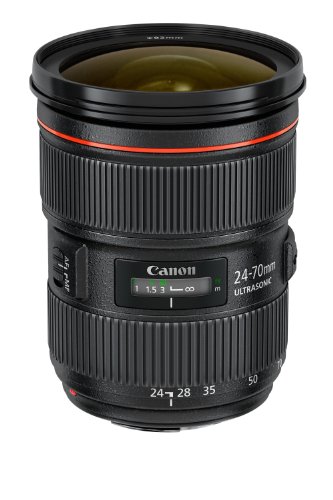
Renewed Canon EF 24-70mm f/2.8L USM provides the same full-frame focal range with high-quality optics and durable build. It supports full-time manual focus, inner focusing, and an aspherical optical design for sharpness across the zoom range. This variant often represents an affordable option for photographers who want the classic L-series performance with a lower upfront cost, while maintaining compatibility with Canon’s EF-mount bodies.
Sigma 24-70mm f/2.8 DG OS HSM Art (Canon EF)

Sigma’s 24-70mm f/2.8 DG OS HSM Art stands out with built-in Optical Stabilization (OS) and a newly designed Hyper Sonic Motor (HSM) for rapid, precise autofocusing. The lens barrel emphasizes rigidity, with optical design that includes multiple glass elements to attenuate aberrations. It is designed to satisfy professional shooters who require dependable performance in news, nature, and other dynamic settings. The OS feature helps preserve sharpness in low-light or handheld scenarios, while the Art series prioritizes high image quality and color rendition.
Canon EF 24-70mm f/2.8L USM (Original)
The Canon EF 24-70mm f/2.8L USM standard zoom is a classic representative of Canon’s L-series: robust construction and classic optical performance. It combines an ultra-low dispersion glass approach with Fluorite elements and an inner focusing mechanism. The lens offers full-time manual focus and a constant f/2.8 aperture, with a 24-70mm focal range that remains popular among Canon DSLR users for its reliable sharpness, contrast, and color rendition across a variety of shooting scenarios.
Buying Guide: Key Purchase Considerations
- Mount ecosystem and compatibility: Ensure the lensmount matches your camera system (Sony E, Canon EF, etc.). Some lenses require adapters for use on non-native bodies; check autofocus performance and stabilization if applicable.
- Aperture and use-case: A constant f/2.8 is ideal for low-light performance and shallow depth of field, but if you prioritize lighter weight, consider f/4 options with IS. For portrait and event work, f/2.8 is often preferred.
- Autofocus performance: Look for fast, accurate AF motors (DDSSM, USM, HSM) and features like par-focal design for video stability. Autofocus consistency matters in fast-moving scenes.
- Optical stabilization: OS/IS systems help with handheld shooting in low light or at longer focal lengths. Consider whether the body has stabilization if the lens does not.
- Weight and handling: Heavier, sturdier lenses balance well on full-frame bodies but can be tiring for long shoots. Factor in your carrying needs and shooting style.
- Image quality indicators: Look for aspherical, low-dispersion elements and coatings that reduce flare and aberrations. The XA (extremely accurate) element and other advanced glass designs help maintain sharpness across the zoom range.
- Durability and weather sealing: For outdoor or travel work, weather sealing and rugged construction offer added reliability in challenging environments.
- Value and availability: Renewed or older models can provide substantial savings, but verify condition, warranty, and compatibility with your camera body and firmware.
This selection spans native premium options, older classic L-series staples, and high-performance Art-level glass. When choosing, weigh your primary camera system, preferred autofocus behavior, and how often you shoot in low light or handheld situations. For video work, consider par-focal designs and continuous AF consistency. Finally, assess whether you need stabilization, as certain lenses rely on camera body IS or lens-based OS to maintain sharpness across dynamic scenes.