Looking to convert your old 8mm and Super 8 films into convenient digital files? This guide highlights five reliable 8mm film scanners that deliver frame‑by‑frame digitization, simple stand‑alone operation, and easy saving to SD cards. Each pick targets a specific buyer type—from casual family archivists to hobbyists wanting frame‑accurate HD video. Below, you’ll find quick pros and a buying table to compare key features side by side.
| Product | Best For | |
|---|---|---|
| KODAK REELS 8mm & Super 8 Films Digitizer | Best for large reels and a big onboard screen | 5″ LCD, frame‑by‑frame, up to 9″ reels |
| eyesen 8mm & Super 8 Film to Digital Converter | Best for compact, simple setups | 2.4″ LCD, no computer required, 32GB card included |
| eyesen Film Maker Pro | Best for precise editing on a standalone unit | 2.4″ LCD, 1080P, included SD card |
| Magnasonic FS81 All‑in‑One Scanner | Best value with reliable playback | 2.3″ LCD, SD card slot, 3″/5″/7″ reels |
| USHNIH 8mm & Super 8 Film to Digital Converter | Best for budget and simplicity | 5‑MP sensor, 1080P, 32GB card included |
| Jancane 8mm & Super 8 Film to Digital Converter | Best for frame‑by‑frame control | 2.4″ LCD, 32GB card included |
KODAK REELS 8mm & Super 8 Films Digitizer

This standalone scanner converts motion picture film strips into digital MP4 files for easy viewing and sharing. It supports 3″, 5″, 7″, 8″ and 9″ reels and uses a large 5″ onboard LCD for navigation. The device emphasizes a frame‑by‑frame digitizing process with an 8.08‑megapixel sensor for clarity, color, and detail. Best for users with multiple reel sizes and a preference for big‑screen controls. Note: Sound is not recorded in the output.
Best for: Families archiving decades of footage; users who want a big built‑in display and a straightforward, no‑computer workflow. Limitation: Requires SD card (not included) for storage and playback.
8mm & Super 8 Film to Digital Converter (eyesen)

This automatic digitizer handles 8mm and Super 8 reels up to 9″ and outputs 1080P MP4 files. A built‑in 2.4″ LCD lets you preview and adjust on the unit, while the included SD card ensures immediate saving. It’s ideal for those who want a portable, computer‑free workflow with a simple, built‑in display. Caution: Some film types may require careful handling to avoid frame skipping during fast motion.
eyesen Film Maker Pro (2.4″ Screen)

The Eyesen Pro model provides a 2.4″ LCD screen for frame‑by‑frame digitization. It supports reels up to 9″ and records directly to SD/SDHC cards (up to 32GB included). It’s suited for users who want a compact, portable device with a straightforward interface and a built‑in viewing screen. Limitation: No sound is captured in the output video.
Magnasonic FS81 All‑in‑One Scanner
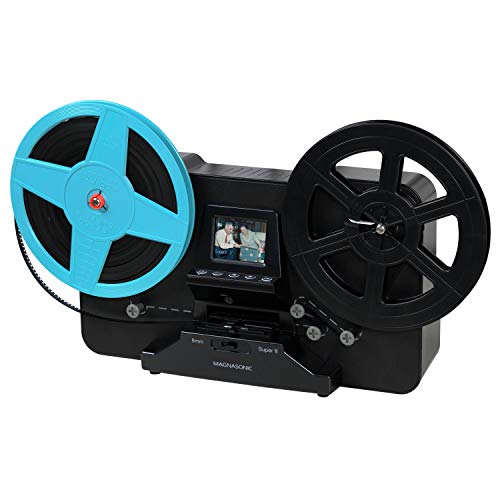
Magnasonic’s FS81 handles 3″, 5″, and 7″ reels with a built‑in 2.3″ LCD and an RCA output for TV viewing. It records to an SD card (up to 32GB). This option is well‑suited for hobbyists who want a simple, no‑frills device to digitize a manageable selection of reels, with a strong emphasis on easy playback on a separate screen. Caution: Sound is not captured in the video files.
USHNIH 8mm & Super 8 Film To Digital Converter

USHNIH offers a budget‑friendly stand‑alone converter with a 5‑megapixel sensor that captures 1080P MP4 videos. It ships with a 32GB SD card and supports up to 9″ reels. It is best for light usage or occasional archiving where keeping costs down matters. Limitation: Frame‑by‑frame precision may be less consistent on rapidly moving footage compared to higher‑end models.
Jancane 8mm & Super 8 Film Converter

Jancane provides a full‑color 2.4″ LCD with touch controls for live record, playback, and on‑screen adjustments. It supports 3″, 5″, 7″, and 9″ reels and saves directly to a 32GB SD card. It’s a solid choice for users who want precise live control over settings like brightness and framing. Caution: Some users may prefer a larger display for easier framing during playback.
Buying Guide
What to consider when choosing an 8mm film scanner:
- Film size support: Ensure the unit handles your reel sizes (3″, 5″, 7″, 9″, and beyond).
- Standalone operation: If you want to avoid a computer, pick a model with an onboard LCD and SD card saving.
- Resolution and frame handling: Look for 1080P output and frame‑by‑frame digitization for best quality and control over each frame.
- Storage: Check included SD card capacity and whether the device supports larger cards via SD/SDHC.
- Sound: Most consumer film digitizers record silent video. If you need sound, this is typically not supported without separate audio capture.
- User interface: A larger display and intuitive controls reduce the learning curve for non‑technical users.
Frequently Asked Questions
- Do these scanners require a computer to digitize film?
- Yes: Some models are standalone, while others may save directly to SD cards without a computer.
- Can I digitize sound from my 8mm film?
- Most consumer film scanners output silent video; sound is generally not captured.
- What file formats do these devices produce?
- Commonly MP4 (H.264/MPEG‑4) video files on the SD card.
- Is 1080P quality sufficient for archival purposes?
- 1080P is widely used for personal archives; for higher fidelity, check model sensor specs and frame handling.