If you’re looking to preserve old 8mm and Super 8 film, a dedicated standalone film digitizer is the fastest path to clear digital copies. These devices typically save directly to SD cards, require no computer, and support common reel sizes up to 9 inches. This guide highlights five reliable options, ideal for different needs such as simple one-reel transfers, larger frames, or frame-by-frame control. The buyer’s intent is addressed with clear suitability notes, practical limitations, and direct-on-device workflow.
| Product | Best For | Reel Sizes Supported | Key Benefit |
|---|---|---|---|
| 8mm & Super 8 Film to Digital Converter (eyesen) | Quick, stand-alone digitizing | 3″, 5″, 7″, 9″ | Built-in 2.4″ LCD for immediate viewing |
| KODAK REELS 8mm & Super 8 Films Digitizer | Frame-by-frame control with large display | 3″, 5″, 7″, 8″, 9″ | Oversized 5″ screen with touch buttons |
| 8mm & Super 8 Film to Digital Converter (USHNIH) | Simple, no-software operation | 3″, 5″, 7″, 9″ | Standalone conversion to 1080P MP4 |
| Magnasonic Super 8/8mm Film Scanner | Basic viewing and transfer | 3″, 5″, 7″ | Built-in 2.3″ screen with TV output |
| Jancane Super 8 Film Digitizer | Compact, easy setup | 3″, 5″, 7″, 9″ | 2.4″ LCD with live playback |
eyesen 8mm & Super 8 Reels to Digital MovieMaker Pro

This fully automated digitizer converts 8mm and Super 8 reels up to 9 inches into 1080P digital MP4 files. It features a built-in 2.4″ LCD screen and saves directly to SD/SDHC cards up to 32GB, with no computer required. Best for users who want a straightforward, stand-alone workflow and immediate playback on the device. Best for: quick, on-site digitizing without software.
Best-for notes: The compact design and direct-to-SD workflow are advantages for single reels or family memories. A potential limitation is that audio is typically not captured; verify if sound is critical for your project.
KODAK REELS 8mm & Super 8 Films Digitizer

The Kodak Reels digitizer offers a frame-by-frame digitizing process with an oversized 5″ touch-enabled screen and supports 3”, 5”, 7”, 8” and 9” reels. It outputs 1080P MP4 files and can transfer to SD cards via USB. Best for: users who want precise frame control and a larger onboard interface. A noted limitation is that sound is not included in the final video.
8mm & Super 8 Film to Digital Converter (USHNIH)

USHNIH’s standalone digitizer supports 3″, 5″, 7″ and 9″ reels and saves to SD/SDHC cards up to 32GB. It emphasizes a simple, software-free workflow, converting to 1080P MP4. It’s best for families with several reels who prefer a single-device process. A limitation to consider is that the device focuses on HD video only and no audio is captured in some models.
Magnasonic Super 8/8mm Film Scanner
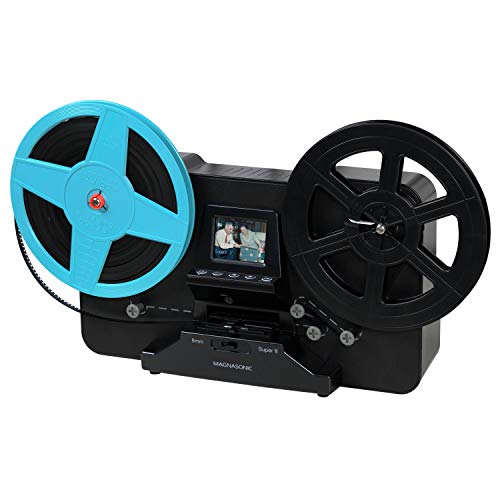
Magnasonic’s scanner converts 3″, 5″ and 7″ reels with a built-in 2.3″ LCD. It can output to a TV with the included RCA cable and saves to an SD card up to 32GB. This option is best for users who want quick playback on a larger screen after digitizing. A potential drawback is the smaller screen compared to other models, which can affect on-device review before saving.
DigitPro VHS to Digital Converter 3.0

DigitPro focuses on converting analog video tapes to MP4, including VHS and Hi8, with a 4K option. It is a standalone device that saves to SD cards or USB drives. This option is best for those who want to digitize mixed media types (tapes and film) in a single setup. Note that this model is oriented toward video tapes more than film reels; it’s suitable when your collection includes both formats.
Buying Guide
What to consider when choosing an 8mm/ Super 8 film digitizer
- Standalone vs. computer-based: Do you want a device that requires no computer, or is a PC-friendly workflow acceptable?
- Reel size support: Ensure the device accepts your reel sizes (3″, 5″, 7″, 9″).
- Display and review: A larger onboard LCD helps frame-by-frame checks before saving files.
- Output format and resolution: Look for 1080P MP4 as a standard; confirm if audio is included or not.
- Storage: Check card compatibility (SD/SDHC) and included memory cards.
- Ease of use: Simple prompts, clear controls, and minimal setup reduce learning curve.
- Expansion and future-proofing: Consider if you will digitize more reels or additional formats later.
Common questions buyers ask
- Do these devices capture sound from film reels? Most standalone units digitize video frames and do not capture original film sound; verify the model specifications for audio capabilities.
- Can I use any SD card? Most devices support up to 32GB SD/SDHC cards; check card compatibility and formatting requirements.
- Is a computer needed for transfer? Some models require no computer, while others offer USB/HDMI outputs for viewing on a larger screen.
- Will there be color correction or filters? Some units offer basic adjustments; higher-end models emphasize frame-by-frame accuracy and color settings.
- Can I digitize multiple reels in one session? Standalone devices are designed for efficiency, but long sessions may require patience and proper storage management.
- What reel sizes are supported? Confirm the reel sizes (3″, 5″, 7″, 9″) to ensure compatibility with your film collection.
These devices provide practical, direct-to-storage workflows for preserving old film content. The right choice depends on your need for frame-level control, screen size for on-device review, and whether you favor a single-device setup or a broader digitization ecosystem.
FAQ
- What is the typical resolution for these devices? Most deliver 1080P MP4 files, suitable for standard viewing.
- Can I edit the footage after digitizing? Some devices save to MP4 so you can edit with external software on a computer if desired.
- Do all units require no computer at all? Several options are standalone, while some can connect to a TV or computer for viewing or transfer.
- Are 8mm and Super 8 treated differently by these devices? Most models handle both formats with mode selections for film type, ensuring proper framing and exposure.
- Is audio captured during digitization? In many models, the output is silent video; verify model specs if audio is important.
- Should I expect color accuracy improvements? Built-in sensors and exposure controls aim for faithful color, but results vary by film age and condition.