Find value-driven tilt-shift lenses that unlock creative perspective control without breaking the bank. This guide highlights five budget-friendly options well-suited for portrait work, architectural scenes, and cinematic miniature effects. The selections span Canon RF, Sony E, and Canon RF-compatible mirrorless bodies, helping photographers and videographers create unique “miniature world” visuals while maintaining practical usability. Each product is evaluated for best-use scenarios, potential limitations, and why it makes sense as an affordable tilt-shift choice. The following table summarizes the five picks to help you compare quickly.
| Product | Mount | Best For | Why It Stands Out |
|---|---|---|---|
| TTARTISAN Tilt 50mm f/1.4 (Canon RF) | Canon RF | Portraits and creative video | Dual function as standard 50mm and tilt-shift; optimized for video with smooth focus control |
| TTARTISAN Tilt 50mm f/1.4 (Sony E) | Sony E | Imaginative stills and miniatures | Compact, versatile, tilt-capable; designed for E-mount mirrorless systems |
| 7artisans 50mm f/1.4 APS-C Tilt-Shift | Sony E Gen APS-C | Budget-friendly miniature and portrait work | 2-in-1 versatility with tilt and shift; strong value for APS-C bodies |
| TTArtisan 35mm f/1.4 (Canon RF) | Canon RF | Compact portrait and miniature effects | Dual-purpose tilt design with stepless aperture for smooth exposures |
| TTArtisan 17mm f/4 Tilt-Shift (Sony E) | Sony E | Architecture and dramatic miniature look | Ultra-wide tilt-shift for expansive scenes and distortion control |
TTARTISAN Tilt 50mm f/1.4 Canon RF Tilt-Shift
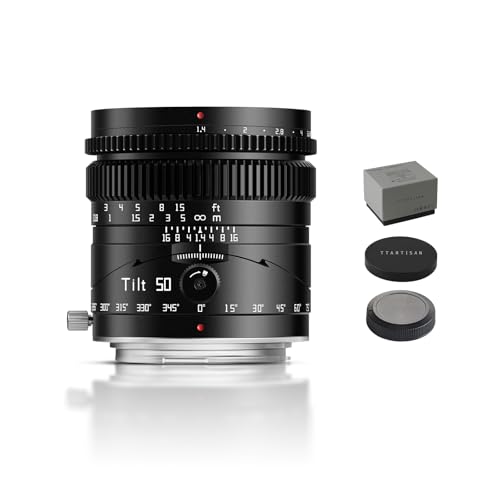
The Magical Lilliput effect meets practical portrait work. This tilt-shift lens combines a traditional 50mm f/1.4 large aperture with tilt capabilities, enabling it to function as both a regular portrait lens and a creative tool for unique images. It’s optimized for video-focused projects, offering smooth focus and aperture control aligned with typical follow focus systems.
- Best for: Portraits, creative video, and miniature-style scenes on Canon RF bodies.
- Why selected: Combines familiar 50mm field with tilt capabilities in one affordable package.
- Limitations: Auto-focused performance isn’t available; relies on manual focus.
TTARTISAN Tilt 50mm f/1.4 for Sony E

Designed for E-mount mirrorless cameras, this version preserves the “miniature world” capability while offering a compact footprint. It’s well-suited for creative portraits and still-life work where tilt shifts help control perspective and depth.
- Best for: Sony mirrorless shooters seeking a portable tilt-shift option.
- Why selected: Similar optical idea as the RF variant, adjusted for Sony’s mount and handling.
- Limitations: Manual focus only; electronic communication varies by body.
7artisans 50mm F1.4 APS-C Tilt-Shift

This APS-C tilt-shift option is a strong value for budget-conscious photographers using Sony APS-C bodies. It delivers a significant blur with its large f/1.4 aperture and supports 360° rotation with tilt-shift axes for flexible composition.
- Best for: APS-C portrait work and miniature-style shots on budget.
- Why selected: Affordable tilt-shift with broad compatibility and good build.
- Limitations: Distortion and flare control aren’t as refined as higher-end models.
TTARTISAN Tilt APS-C 35mm f/1.4 (Canon RF Mount)

Combining a classic f/1.4 aperture with tilt for miniature-style effects, this lens is aimed at Canon RF users seeking a more compact option for portraits and creative scenes. It offers a stepless aperture for smoother exposure transitions in video work.
- Best for: Canon RF buyers who want a compact tilt option with strong portrait performance.
- Why selected: 35mm focal length suits everyday photography with tilt for creative depth control.
- Limitations: APS-C design may require crop-sensor framing adjustments on full-frame bodies.
TTARTISAN Tilt-Shift 17mm f/4 (Sony E)

An ultra-wide option that emphasizes architectural clarity and dramatic miniature aesthetics. The ±8mm shift helps preserve straight lines in wide scenes, while tilt offers creative miniature perspective.
- Best for: Architecture and expansive interior shots with corrected perspective.
- Why selected: The ultra-wide shift performance expands creative possibilities beyond standard portraits.
- Limitations: Wide angle can exaggerate perspective if not carefully managed.
TTArtisan 35mm f/1.4 Tilt for Micro Four Thirds

Specifically designed for Micro Four Thirds, this 35mm tilt-lens option adds miniature world capabilities with the familiar f/1.4 brightness. It’s suitable for G-series and PEN cameras seeking a compact tilt solution with strong image quality.
- Best for: MFT users seeking a compact tilt option with strong subject separation.
- Why selected: Good balance of size, cost, and creative potential for MFT bodies.
- Limitations: MFT format may require different field of view compared to APS-C or full-frame systems.
Buying Guide: Tilt-Shift Lenses Without Breaking the Bank
What should you consider when choosing an affordable tilt-shift lens? The key factors below help you align gear with your creative goals and camera system.
- Mount compatibility: Ensure the lens matches your body (Canon RF, Sony E, Micro Four Thirds, etc.).
- Focal length and format: Shorter primes (35–50mm) are versatile for portraits and miniature effects; wider angles enable architectural control but exaggerate perspective if not used carefully.
- Tilting and shifting range: Look for tilt and shift axes described by the manufacturer; practical ranges affect ease of use and creative options.
- Aperture behavior: Stepless or smooth manual control helps video and low-light work; fixed or easy-to-use diaphragms improve consistent exposure.
- Build and operation: All-metal builds feel sturdier; check for smooth focusing rings and reliable gear engagement with follow focuses.
- Image quality considerations: The balance between sharpness, contrast, and distortion control; expect some contrast trade-offs at wide apertures.
- Budget and future-proofing: A lower cost now may justify upgrades later if you want more professional-grade controls or higher image quality.
FAQ
- What is a tilt-shift lens used for?
It shifts perspective and tilts the lens to control the plane of focus, enabling miniature world effects and corrected architectural lines.
- Are affordable tilt-shift lenses good for video?
Yes, many offer smooth manual focus and depth control ideal for stylized video shots, though some lack electronic autofocus.
- Which mount should I choose for a tilt-shift lens?
Pick the mount that matches your camera system (Canon RF, Sony E, Micro Four Thirds) to avoid adapters and maximize usability.
- Do tilt-shift lenses correct distortion?
Tilt-shift lenses primarily control perspective and depth; they help maintain straight lines in architecture but may introduce other distortions at extreme shifts.
- Can I use tilt-shift lenses on full-frame and APS-C bodies?
Yes, but the effective field of view and image circle differ; some lenses are designed specifically for crop sensors.
- Is manual focus a challenge with tilt-shift lenses?
Manual focus encourages deliberate focusing for miniature effects; on some bodies, follow-focus rigs can ease operation.