If you’re looking for an auto feed slide scanner to digitize large slide collections fast, these models are designed to streamline the process. The top picks here are best suited for collectors, hobbyists, and archives managers who want reliable batch scanning, simple workflows, and good color accuracy without complex setup. Below, you’ll find a quick summary of the best options and a buyer-focused guide to help you choose.
Summary of selected products:
| Product | Best For | Why It Stands Out |
|---|---|---|
| Plustek OpticFilm 8300i Ai | Serious archivers who want color-accurate, batch-ready 35mm scans | New chip, fast scan speeds; includes SilverFast Ai Studio; IT8 calibration target |
| Pacific Image PowerSlide X Plus | Bulk slide scanning with reliable batch processing | Auto batch scanning up to 50 slides; true color 10,000 dpi; easy interface |
| Plustek OpticFilm 135i | 35mm film and slide enthusiasts needing high edge stability | 3rd generation lens; infrared enhancement for dust/scratch suppression |
| KODAK Slide N Scan Max | Home users seeking a versatile 7” display and simple workflow | 7” tiltable LCD; quick-feed tray; easy preview and transfer |
| Magnasonic All-in-One 24MP | Casual buyers needing an all-in-one solution | Standalone unit with 5” display; supports multiple film formats |
Plustek OpticFilm 8300i Ai Film Scanner
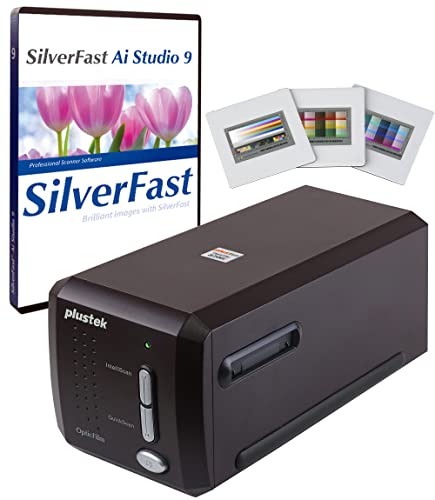
Best for dedicated film archivists who want a fast, professional-grade 35mm scanner. The 8300i Ai packs a new-generation sensor that speeds up scanning by about 38% over its predecessor. It includes SilverFast 9 Ai Studio for advanced color management and a Quick Scan Plus workflow, making it easier to digitize and archive slides and films. It comes with an advanced IT8 calibration target (three 35mm slides) to improve color accuracy and reduce interpolation during calibration.
Designed for serious users, this model is a strong choice when you need high-quality scans with precise color calibration. Caution: software suite requires familiarity with professional imaging tools; setup may be more involved than entry-level scanners.
Pacific Image PowerSlide X Plus 35mm Slide Scanner

Best for fast bulk slide scanning with minimal handling. PowerSlide X Plus supports auto batch processing of up to 50 slides, enabling efficient digitization of large collections. It uses a true RGB linear array CCD for high-quality 135 slide scanning and offers a user-friendly interface with one-button operation. Limitation: batch processing may require compatible slides and magazine setup for optimal results.
Plustek OpticFilm 135i Ai

Best for 35mm film and slides with high-resolution output and robust edge stability. The 135i Ai uses a 3rd-generation 5-element lens to reduce light refraction and improve infrared dust/scratch detection. It supports multiple 35mm film types and offers infrared enhancement to boost MTF. Choose this if you want reliable edge-to-edge sharpness and strong dust/scratch handling. Limitation: panoramic and special-width formats may require optional holders.
KODAK Slide N Scan Max Digital Film Scanner

Best for home users seeking a versatile 7-inch LCD and quick preview. The Slide N Scan Max can transform negatives and slides into digital files and displays them on a tiltable LCD, making it easy to view and edit directly. It includes a quick-feed tray for continuous scanning and adapters for different film formats. Caution: built-in display is convenient but not a replacement for professional color grading, if color accuracy is critical you may want post-scan editing.
Magnasonic All-in-One 24MP Film Scanner

Best for casual users who want a standalone scanner with a built-in display. The Magnasonic FS71 converts 35mm, 110, 126, and Super 8 formats to 24MP digital JPEGs. It features a built-in memory and SD card slot for easy saving and sharing without a computer. Limitation: scan quality and color may vary compared to higher-end, dedicated scanners; ideal for quick digitization rather than professional archives.
Plustek OpticFilm 135i Ai (Second Listing)

Best for professional-grade scans with a focus on infrared dust detection and edge stability. This variant emphasizes AI-assisted workflows and includes an advanced IT8 calibration target with three slides, aligning with archival-grade needs. It’s suitable for users who want top-tier scan fidelity and robust post-processing options through SilverFast Ai Studio.
Buying Guide
What to consider when choosing an auto feed slide scanner:
- Batch capacity: How many slides can be scanned in one pass? Higher capacity saves time for large collections.
- Resolution and color accuracy: Look for true color scanners and options for calibration (IT8 targets) to minimize color shifts.
- Software ecosystem: Professional tools (like SilverFast) offer advanced features but may require a learning curve.
- Standalone vs. computer-connected: Standalone units are simple but may offer fewer editing options; computer-connected scanners often allow deeper processing.
- Film format support: Ensure compatibility with the specific film types you own (35mm, 110, 126, Super 8, etc.).
- Ease of use: One-button or guided workflows help reduce setup time for casual users.
- Physical design and media handling: Look for robust slide magazines and reliable feeders to minimize jams or scratches.
- Calibration and maintenance: Regular calibration improves fidelity; check availability of calibration targets and support.
FAQ
- What is an auto feed slide scanner?
It’s a scanner designed to automatically feed multiple slides into the scanner, enabling batch digitization for faster processing.
- Do professional-grade scanners require software knowledge?
Some do; professional packages offer advanced controls which can improve color and sharpness but may require time to learn.
- Is it better to choose standalone or computer-connected scanners?
Standalone units are simpler to use, while computer-connected models often provide more powerful editing options.
- Can these scanners handle different slide formats?
Most models support common formats like 35mm; always verify compatibility with specific slide types you own.
- What is IT8 calibration and why is it important?
IT8 targets calibrate color across devices, helping achieve more accurate color reproduction in scans.
- Are higher dpi guarantees better results?
Higher dpi can improve detail, but color accuracy, dynamic range, and dust/scratch handling also matter for overall quality.