For professionals and hobbyists exploring 3D scanning, the right camera setup can dramatically improve accuracy, speed, and ease of use. This guide highlights five top options that blend precision, portability, and compatibility with common workflows. Each choice targets different scanning scenarios—from dense indoor spaces to outdoor landmarks and real-time monitoring of 3D printing processes. Use the buying guide below to compare features, formats, and capture ranges to fit your project needs.
| Product | Brand | Capture Range / Details | Best For |
|---|---|---|---|
| Matterport Pro3 | Matterport | Ultra-precise LiDAR; up to 100 m range (files) with 10 m high-precision scans | Large indoor spaces and professional virtual tours |
| IFWATER 3D Stereo USB Camera | IFWATER | Dual 4 MP lenses; 60 FPS at 1080p; 180° FOV | Real-time depth detection and 3D reconstruction |
| EINSTAR Vega | EINSTAR | VCSEL + MEMS; 270–1500 mm (fast) and 100–350 mm (HD); outdoor ready | Flexible outdoor and indoor scanning with portable design |
| 3DMakerpro 3D Scanner | 3DMakerpro | 0.01 mm precision; 24-bit color; 10 FPS | Detailed object scanning for 3D printing |
| KanDao QooCam EGO | KanDao | 24 MP photos; 8K, 4K 60FPS video; stereoscopic 3D | Immersive 3D content creation and VR ready |
Note: This article uses five representative devices that align with 3D capture needs—from room-scale tours to portable object scanning and immersive video. Prices and availability may vary by retailer and region.
Matterport Pro3 Performance Kit

Matterport Pro3 is designed to capture spaces with high fidelity using an ultra-fast LiDAR sensor. The camera collects millions of measurements per scan, delivering precise geometry and rich 3D data for indoor and outdoor environments. Its extended scanning range supports large spaces, while the overall workflow emphasizes accurate, photo-realistic virtual tours and 4K photography alongside 360 views. The Pro3 is optimized for professional-level virtual tour creation and real-world measurement accuracy, suitable for commercial spaces, architectural visualization, and real estate marketing.
Key features include an extended scanning range up to 100 m (for certain file types), a high-precision LiDAR system, and robust performance for complex environments. The combination of rapid data capture and accurate rendering makes it a strong choice for studios and agencies prioritizing trustable spatial representations.
IFWATER 3D Stereo USB Camera

The IFWATER 3D Stereo USB Camera provides high-speed depth sensing through dual 4 MP lenses and a 180-degree field of view. With 60 frames per second at 1080p, it enables precise depth detection essential for 3D reconstruction and real-time depth maps. This camera is designed for plug-and-play use, supporting Windows, Linux, Android, and Mac systems, and is suitable for facial recognition, QR code scanning, and industrial security contexts. It is particularly well-matched to projects requiring fast imaging and reliable stereo correspondence for rapid 3D model generation.
ANYCUBIC Camera Kobra 3

3D printing enthusiasts can leverage the Anycubic Kobra 3 camera for real-time monitoring and remote supervision of print jobs. This camera provides ultra-clear resolution suitable for documenting layer progression and final models. Its compatibility with Anycubic’s ecosystem and Klipper workflows makes it a practical addition for users who want to supervise prints, review outcomes, and create time-lapse records of the printing process. While not a full-scanning LiDAR solution, it complements 3D printing pipelines by improving visibility and process control.
Matterport Pro3 3D Lidar Scanner

The Matterport Pro3 3D Lidar Scanner mirrors the Pro3’s core capabilities with continued emphasis on rapid, precise 3D capture and professional-grade virtual tour delivery. It supports 360-degree views and 4K photography to create immersive, accurate representations of spaces. This option is ideal for firms performing architectural visualization, real estate showcases, or corporate space planning where detailed spatial data and a polished final presentation are required. Its accuracy and speed help teams scale scanning projects efficiently across multiple rooms or venues.
EINSTAR Vega 3D Scanner

EINSTar Vega blends VCSEL and MEMS projection for versatile scanning, offering both long-range and high-detail modes. Its all-in-one design includes internal computing and data archiving, making it a portable option for fieldwork. The Vega’s infrared-based capabilities support outdoor scanning under sunlight, with reliability in challenging lighting conditions. This makes it a practical choice for scanning artifacts, larger outdoor objects, and environments where traditional structured-light methods may struggle.
3DMakerpro 3D Scanner
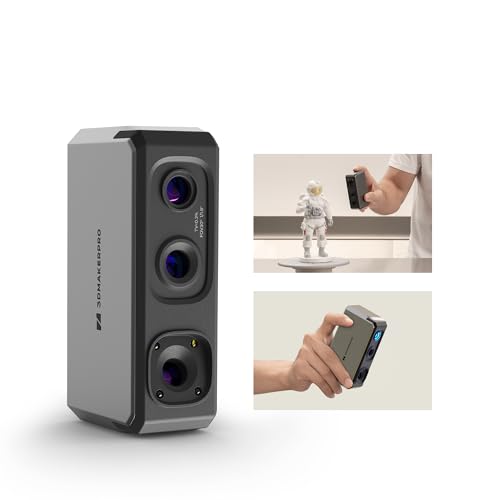
The 3DMakerpro 3D Scanner emphasizes precision with 0.01 mm accuracy and a 24-bit color camera for vivid textures and accurate color reproduction. Its 10 FPS scanning speed supports iterative design cycles and rapid generation of printable 3D models. Anti-shaking stabilization reduces motion blur during scans, making it suitable for tasks that require stable, high-detail captures of small to medium-sized objects. This device aligns well with hobbyist-to-professional workflows where color fidelity matters as much as geometry.
KanDao QooCam EGO

QooCam EGO focuses on immersive 3D capture with true-to-life stereo depth. It features 65 mm baseline for accurate parallax, 8K photos and 4K 60FPS video in stereoscopic format, and an integrated IMU with image stabilization for smooth motion. The device is designed for VR display compatibility and easy sharing through QooCam apps, making it a strong option for creators who want high-quality 3D content suitable for VR headsets and social sharing. It emphasizes user-friendly workflow alongside robust 3D output.
Buying Guide
Key purchase considerations help you choose the right camera for 3D scanning tasks. Assess the following from your perspective and project requirements:
- Capture range and space type: For large interiors, look for LiDAR-assisted or long-range scanners (e.g., Matterport Pro3). For small objects or mobile scanning, compact cameras with high-resolution sensors may suffice.
- Depth sensing method: LiDAR provides robust performance in varying lighting, while stereo cameras and structured light excel in controlled environments. Outdoor usability should factor lighting conditions and drift tolerance.
- Resolution, color, and texture: 24-bit color and high-resolution sensors yield more realistic textures, which matter for marketing renders and product models.
- Portability and workflow: All-in-one designs are convenient for field work, whereas modular setups may offer greater flexibility. Consider ease of data transfer, processing power, and software compatibility.
- Output formats and software compatibility: Ensure the camera integrates with your preferred 3D software, VR platforms, and cloud services. Some devices provide native apps or robust SDKs for customization.
- Durability and environment readiness: Outdoor scanning may require weather resistance or shielding from direct sunlight. Infrared-based and robust cameras handle diverse settings.
- Cost of ownership: Beyond initial purchase, factor in data processing needs, storage, and potential subscription services for software and cloud processing.
In choosing, balance accuracy, speed, and the intended output. If reliable, professional-grade virtual tours are critical, prioritize LiDAR-based systems with proven spatial fidelity. For object scanning and educational purposes, high-resolution color capture and flexible software are advantageous. For VR content and immersive storytelling, stereoscopic 3D cameras with strong stabilization and easy sharing offer significant value.