Choosing the right camera system for trucks, RVs, and trailers can improve safety, reduce blind spots, and simplify reversing in tight spaces. This guide highlights five reliable kits with features like 360° coverage, night vision, DVR recording, and easy installation. Each option is designed to suit large vehicles while balancing wired and wireless setups. Read on to compare core strengths and pick the system that best fits your vehicle size, driving conditions, and tech preferences.
Summary of chosen products:
| Product | Brand | Key Strengths | Display Size | Connectivity |
|---|---|---|---|---|
| RV Camera System with CarPlay & Android Auto | Venluna | 360° blind-spot coverage, time-lapse parking, wireless CarPlay/Android Auto | 10.36″ | Wireless |
| 7-Inch Wireless Backup Camera for Truck | LeeKooLuu | HD 1080P, night vision, easy one-click channel switching | 7″ | Wireless |
| Wired Backup Camera System with 10.1″ IPS Monitor | Losuudy | 4-camera 1080P, recording function, large monitor | 10.1″ | Wired |
| 4 Channel Backup Camera System with DVR | Camotop | DVR, 10.26″ touchscreen, 4-channel display | 10.26″ | Wired |
| 7″ 1080P AHD Wired Reversing System | ATPTK | Industrial-grade, IP69K, wide vehicle power range | 7″ | Wired |
Venluna RV Camera System With CarPlay
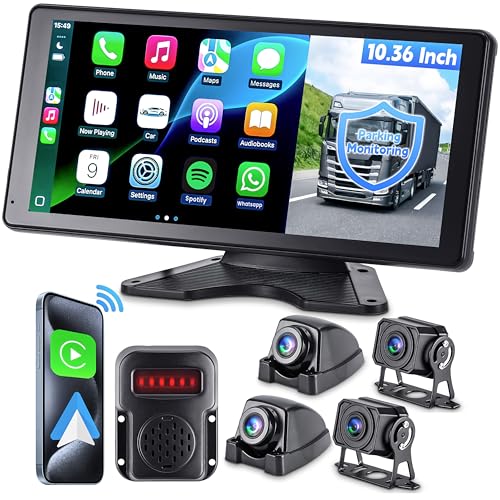
The Venluna system offers 360° blind-spot monitoring through four HD cameras, providing real-time coverage around large vehicles. It includes customizable zones with audible and visual alerts to help prevent collisions in tight spaces. A 10.36-inch monitor serves as the central hub for viewing feeds and navigating CarPlay/Android Auto integration via Bluetooth and WiFi, reducing cable clutter while keeping navigation and media at the driver’s fingertips. Parking monitoring is enhanced by 24-hour time-lapse recording when the engine is off, potentially capturing theft or damage while parked.
LeeKooLuu 7-Inch Wireless Backup Camera for Truck

This 2-channel wireless kit focuses on quick, tool-free setup. It pairs a 7-inch monitor with a backup camera that delivers HD 1080P clarity and night vision. A key feature is one-click channel switching, enabling drivers to toggle between camera views and even switch to a split-screen mode to monitor multiple angles—handy for parking trailers or attaching to towed loads. The system is designed to be pre-paired, minimizing installation time for busy drivers.
Losuudy 10.1-Inch IPS Wired Backup System

The Losuudy setup emphasizes a wired backbone with a large 10.1-inch IPS monitor for clearer, more expansive viewing. It supports recording and optional multi-camera video playback, with four cameras providing front, rear, and side views. The AHD 1080P feed ensures consistent high-definition imagery, while the system’s compatibility with a wide 12V-36V range helps fit a broad range of RVs, buses, and trucks. This kit is ideal for drivers who prioritize a dedicated, stable wired connection and long-term durability in rugged environments.
Camotop 4 Channel Backup System With DVR

Camotop combines a powerful onboard system with a built-in DVR and a 10.26-inch touchscreen. The interface supports viewing multiple channels simultaneously and configuring 1-4 channel displays. DVR recording enables capturing trips and incidents for later review, while the large monitor improves visibility during parking, hitching, and reversing. The system is designed to be robust for RVs, trucks, and trailers, delivering a balance of convenience and functionality for drivers who log long hours on the road.
ATPTK 7-Inch AHD Wired Reversing System

The ATPTK option is an industrial-grade wired camera system designed for heavy-duty applications. It features a 7-inch monitor and a single-camera to multi-camera compatibility with a wide DC12-24V input range, suiting large vehicles from buses to tractors. The IP69K-rated camera provides strong resistance against water and dust, with night vision for low-light operation. Built to handle significant vehicle vibration and wide operating conditions, this kit aims to deliver reliable performance across environments.
Buying Guide: Key Purchase Considerations
- Wired vs. wireless: Wired systems tend to offer more stable signals and longer cable runs for large vehicles, while wireless kits are quicker to install and easier to relocate between vehicles.
- Monitor size and resolution: Larger monitors (8–12 inches) improve visibility when backing a trailer or navigating crowded lots. Look for 1080P or similar HD resolution for crisp images.
- Camera count and coverage: For trucks and RVs, four cameras can provide 360° coverage. Consider front, rear, and side cameras, plus blind-spot monitoring features if available.
- Night vision and weather resistance: IP69K or equivalent ratings protect cameras in rain, snow, and road spray. True night vision ensures visibility in low light.
- Recording and storage: DVR or NVR capabilities let you capture incidents. Check max supported storage and whether memory cards or USB drives are needed.
- CarPlay/Android Auto and smart integrations: Wireless CarPlay/Android Auto can streamline navigation and media control, reducing device clutter and distractions.
- Power requirements: Ensure the kit supports your vehicle’s power range (12–24V, etc.) and consider whether parking mode or ACC integration fits your routine.
- Installation effort and durability: Heavier-duty kits may require professional installation, especially for larger fleets or commercial use. Assess warranty and customer support.
- Future expandability: If you might add more cameras or upgrade to higher-definition feeds later, choose a system with flexible camera options and upgrade paths.
These considerations help compare how each camera system fits common trucking and RV scenarios, from daily towing to long-haul trips. When selecting, balance the need for visibility, ease of use, and reliability against the vehicle type and typical driving environment.