For hobbyists who want to capture aerial perspectives, the right camera-equipped RC helicopter blends stability, control, and real-time video. This guide highlights five versatile options designed for beginners to seasoned pilots, featuring live FPV feeds, altitude hold, and straightforward takeoff/landing. Each entry includes core specs and why it matters for in-flight imaging and navigation.
Summary of selected products
| Product | Brand | Camera Type | Key Benefit |
|---|---|---|---|
| Helicopter Remote Control LM19 Ospery | OBEST | 1080P HD Front & Bottom Cameras | Dual views with FPV live transmission |
| LM19-D Chinook RC Helicopter | OBEST | 720P HD Front Camera | Altitude hold and stable flight |
| Cheerwing U12S Mini RC Helicopter | Cheerwing | WiFi FPV Camera | Real-time video via smartphone app |
| RCTRORCARY C128 RC Helicopter | RCTRORCARY | Camera capable, FPV-ready | One-key takeoff/landing; stable in light winds |
| SREJNGL Large 72CM 4K Dual Camera | SREJNGL | 4K dual camera with LED lights | Night-friendly flight and broad coverage |
OBEST LM19 Ospery Military RC Helicopter With Live Camera

The LM19 Ospery integrates a dual-camera setup to capture from front and ground perspectives. It features one-key takeoff/landing, land gliding, and a headless mode, simplifying operation for beginners. The accompanying app offers Gravity Sensor-driven flight, letting you steer by tilting your phone, while the 1080P HD front camera records high-definition aerial footage and photos. Real-time FPV transmission streams live video to a connected device for immediate viewing, enhancing the flying experience.
Key considerations include app reliability, camera stabilization, and flight modes that support both creative filming and stable hovering. This model emphasizes beginner-friendly automation and smartphone control to broaden FPV opportunities without needing advanced piloting skills.
OBEST LM19-D Chinook RC Helicopter With Camera

The LM19-D Chinook offers a realistic 1:100 scale look with a dual-propeller design and a 720P camera for aerial capture. Its altitude-hold feature helps maintain a steady hover, improving ground-to-air video consistency. A 2.4GHz controller reduces interference and expands control range, making it feasible for both kids and adults to enjoy FPV-style flights. The remote’s gyroscopic stabilization supports smoother maneuvers during filming and reconnaissance-style flights.
From a filming perspective, the Chinook is well-suited to capturing sweeping landscape shots and close-ups of ground detail. Users should consider storage options and the stability of the camera during rapid maneuvers or wind gusts, as these factors affect image quality in the final footage.
Cheerwing U12S Mini RC Helicopter With Camera
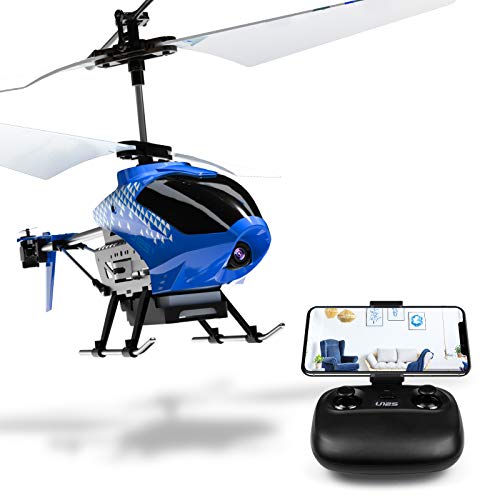
The Cheerwing U12S delivers a compact, user-friendly FPV experience with a built-in WiFi camera that streams live video to a connected smartphone. Its one-key takeoff/landing simplifies initial flights, while an altitude hold function aids beginners and kids in achieving a stable hover. The combination of small form factor and live video makes it ideal for indoor practice and introductory FPV sessions, with the potential for casual aerial photography and video capture.
Considerations include WiFi range and potential interference in tight spaces, as well as ensuring the phone app remains compatible with current devices for reliable live feed and control.
Cheerwing U12S Mini RC Helicopter With Camera (Variant)
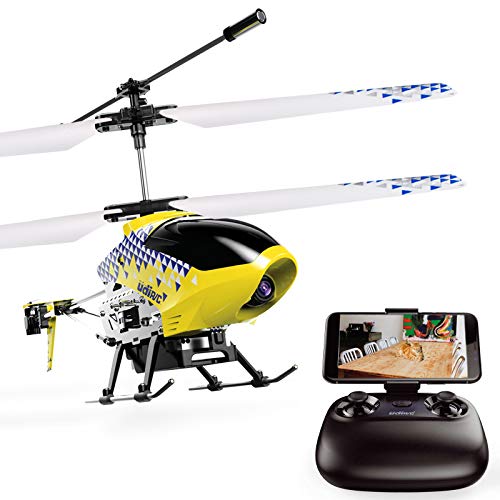
This second Cheerwing entry shares the core features of the U12S family: WiFi FPV transmission, live camera feed, and an easy one-key takeoff/landing. The auto-hover capability helps maintain a stable height, supporting both new flyers and those practicing cinematic shots from above. Users should evaluate whether this variant’s camera quality and app performance meet their specific video capture needs, especially in variable lighting or larger rooms.
RCTRORCARY C128 RC Helicopter With Camera
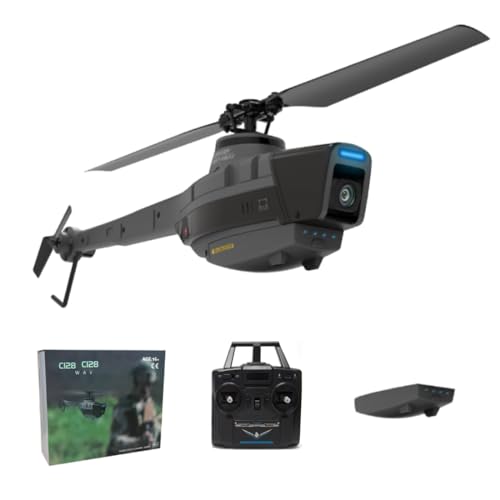
The C128 model focuses on a balance between beginner-friendly control and photography capability. It emphasizes quick one-key takeoff/landing, stable hover via a robust rotor system, and 4CH control that helps maintain steady performance in light winds. The included camera capability enables sharp sky imagery and aerial photography, making it suitable for those who want an easily controllable FPV platform without complex setup. Prospective buyers should assess wind tolerance and the depth of control features offered by the remote controller.
SREJNGL Large 72CM 4K Dual Camera RC Helicopter

Designed for larger-scale aerial videography, the SREJNGL model features a 4K dual-camera setup and bright LED navigation lights for night flights. The dual camera arrangement supports different shooting angles—front and ground views—while the included 2.4GHz remote control provides a robust control range for outdoor use. A larger airframe enhances stability, but potential buyers should evaluate battery life and charging options, especially for extended filming sessions.
Buying Guide
Camera-equipped RC helicopters balance flight stability, control simplicity, and image quality. When choosing, consider these factors:
- Camera quality and viewing options: Front-facing, ground-view, or dual cameras impact how you capture footage. Higher resolutions (1080P or 4K) deliver crisper video, but may reduce flight time due to power demands.
- Flight stability features: Altitude hold, headless mode, and gyro stabilization improve smooth footage, especially for beginners learning to hover.
- FPV and control setup: WiFi FPV and app-based control offer real-time video, but check latency and range. A separate radio controller with 2.4GHz transmission can reduce interference for outdoor flights.
- One-key takeoff/landing: Simplifies operation, particularly for new pilots, and reduces the risk during setup and gusty conditions.
- Battery life and charging: Flight time varies widely. Look for models with multiple batteries or USB charging options to extend shooting sessions.
- Size and wind tolerance: Larger models tend to be more stable outdoors, while smaller models excel indoors. Consider where you plan to fly most often.
- Durability and materials: ABS plastics and reinforced frames help withstand crashes common in learning phases, preserving camera components.
- Repairability and spare parts: Check availability of replacement parts such as blades, landing gear, and camera modules to minimize downtime.
- Safety and legality: Ensure flights comply with local regulations, especially for FPV and flying near people or restricted airspace.
When evaluating options, compare overall value across camera capabilities, ease of use, and flight stability. For casual filming, a lighter, app-controlled model with decent stabilization may suffice. For enthusiasts pursuing cinematic shots, a larger platform with a robust camera system and reliable FPV link tends to deliver more consistent results.