For hobbyists and engineers, selecting a compact CMOS camera sensor module can unlock a world of embedded vision projects. This guide focuses on popular, low-power modules with I2C/SCCB interfaces that pair well with microcontrollers and single-board computers. Each option below highlights core specs, sensor type, and output capabilities to help you compare performance, power use, and integration ease. Whether you’re prototyping a robotic vision system or adding image capture to an Arduino project, these modules provide practical starting points.
| Product | Brand | Sensor Type / Resolution | Output / Interface | Notes |
|---|---|---|---|---|
| HiLetgo 2pcs OV7670 640×480 | HiLetgo | OV7670, 640×480 | I2C, VGA/YUV output | Low power, 15fps operation |
| EC Buying OV2640 Camera Module | EC Buying | OV2640, 2MP | JPEG/RGB565 output | High sensitivity, flexible parameter settings |
| 2PCS OV7670 VGA Module | YFUSET | OV7670, 640×480 | I2C SCCB, VGA YUV | Two-pack, low power |
| JESSINIE OV2640 Camera Module | JESSINIE | OV2640, 2MP | JPEG / RawRGB / YUV | Wide output formats, 140° wide angle |
| hiBCTR 4-Pack OV7670 Module | hiBCTR | OV7670, 640×480 | I2C | Quad pack, low power |
Note: The listed features are summarized from each product’s specification and are intended to help you compare core capabilities quickly. Always verify current availability and exact pinouts for your project needs.
HiLetgo OV7670 640×480 Camera Module Pair

The HiLetgo OV7670 module provides 640×480 VGA resolution with a compact 2.5V–3.0V I/O range and an internal LDO that regulates the core to 1.8V. Operating at approximately 60 mW, it supports 15 frames per second in VGA/YUV output, making it a practical choice for simple vision tasks and Arduino-compatible experiments. The dual-pack offers cost-effective redundancy for testing multiple camera angles or calibration routines, while keeping the interface straightforward via I2C (SCCB) controls.
EC Buying OV2640 2MP Camera Module

The OV2640-based EC Buying module features a 2 megapixel sensor with JPEG output support and flexible configuration for exposure, white balance, chroma, saturation, and contrast. Its small form factor and low operating voltage enable compact designs for embedded systems, microcontrollers, and single-board computers. The module provides all functions of a compact UXGA camera and image processor, suitable for projects requiring higher image quality and richer color data in JPEG or RGB565 formats.
2PCS OV7670 Camera Module Suite

This listing combines two OV7670 modules offering 640×480 VGA resolution with a built-in I2C SCCB interface. The modules share a low power profile at 60 mW in VGA YUV mode and operate within a 2.5V–3.0V IO window, delivering a 1.8V core voltage via internal LDO regulation. Auto-control features such as exposure, gain, and white balance help stabilize image output across changing light conditions, useful for quick prototypes and sensor tests in embedded projects.
JESSINIE OV2640 2MP Camera Module

The JESSINIE OV2640 module combines a 2MP sensor with a broad set of output formats, including JPEG, RawRGB, and YUV variants. The 140-degree wide-angle lens expands scene capture, beneficial for surveillance, robotics, and wide-field monitoring. The sensor supports various raw and compressed data formats, enabling flexible integration with microcontrollers and image processing pipelines that require either compressed JPEG for storage or uncompressed data for on-the-fly analysis.
Treedix OV2640 2MP Wide-Angle Module

The Treedix OV2640 module packs a 1/4-inch CMOS UXGA sensor with 1632×1232 resolution and a wide-angle 140-degree lens. It can output 8- or 10-bit image data via SCCB control, with support for multiple resolutions and processing modes, including window extraction and sub-sampling. Capable of up to 15 frames per second at UXGA, this module is suited for embedded vision tasks that demand higher resolution for object recognition or documentation in compact form factors.
hiBCTR 4-Pack OV7670 VGA Modules
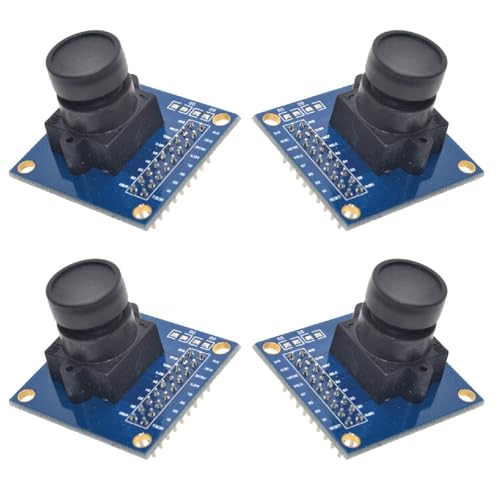
This 4-pack combines OV7670 VGA modules, each with a 640×480 sensor and a 2.5–3.0V I/O range. The 60 mW per module energy profile suits battery-powered experiments, while integrated auto-image optimization features—exposure, gain, white balance, anti-bloom, and black-level calibration—help adapt to varying lighting. The density of four units enables multi-camera setups for stereo vision tests or cross-calibration in larger projects without committing to a single module.
Comimark VGA OV7670 Dual Module Set

The Comimark set delivers a pair of OV7670 modules with I2C/SCCB control and VGA resolution. These modules are designed for straightforward Arduino compatibility and provide a cost-effective option for dual-camera experiments, stereo depth perception tests, or synchronized data capture across two perspectives. Their compact footprint supports enclosure-friendly deployments and rapid prototyping in embedded vision projects.
Buying Guide: Key Purchase Considerations
Sensor choice matters for image quality, color fidelity, and light sensitivity. OV7670 modules are lightweight, low-power, and ample for simple tasks, while OV2640-based modules offer higher resolution and JPEG output, better suited to scenarios requiring richer imagery or compressed storage. Consider the following factors when selecting a module:
- Resolution and sensor type: OV7670 (VGA) vs OV2640 (2MP). Higher resolution improves detail but increases data throughput and processing needs.
- Output format: JPEG offers efficient storage and streaming; RAW/RGB565 suits real-time processing and custom pipelines.
- Power and voltage: Check I/O voltage range (commonly 2.5–3.0V) and core voltage regulation to ensure compatibility with your controller and power budget.
- Interface: I2C/SCCB for control; ensure your microcontroller has sufficient GPIOs and timing for sensor configuration.
- Lens field of view: Wide-angle modules (e.g., 140°) capture broader scenes but may introduce distortion; plan for calibration if precise measurements are needed.
- Package and quantity: Multi-pack offerings can reduce cost for multi-camera setups or experiments requiring redundancy.
- Processing requirements: Higher resolution and advanced features (auto exposure, white balance) may demand more CPU or dedicated processing hardware.
Practical deployment tips include testing exposure settings under your typical lighting, validating color accuracy with a reference chart, and ensuring stable power supply to prevent image artifacts. For robotics or wearable projects, prioritize low power consumption and compact form factors. When building a proof-of-concept, OV7670 modules provide fast iteration, while OV2640 modules enable higher fidelity documentation and more complex imaging tasks.