The best CS-mount lens for your Raspberry Pi HQ Camera depends on your intended use, budget, and emphasis on wide vs. telephoto performance. This guide highlights five solid CS-mount options, with clear notes on who they are best for and potential limitations. Whether you’re shooting macro scenes, landscapes, or distant subjects, these lenses help you tailor field of view and focus accuracy. Ideal buyers include hobbyists building a surveillance or time-lapse rig, educators teaching imaging, and makers pursuing precise manual control over focus and aperture.
| Product | Best For | Notes |
|---|---|---|
| Arducam 6mm Wide CS-Mount | Compact setups, budget-conscious | Reliable baseline FOV with manual focus |
| Arducam 8-50mm C-Mount Zoom | Flexible distance, manual control | Versatile focal range, best with stationary subjects |
| Arducam 6mm Wide CS-Mount with Adjustable Aperture | Low-light and depth control | Same basics with adjustable iris |
| Arducam CS-Mount Lens Kit (6/8/12/16/25mm) | All-in-one starter kit | Multiple focal lengths in one box |
| Zowietek 5-50mm Zoom CS Mount | Longer reach, industrial use | Manual focus/zoom, high versatility |
Arducam 6mm Wide CS-Mount Lens

Best for compact Raspberry Pi HQ camera builds. This CS-mount lens offers a straightforward wide view with minimal shading and reliable image quality. It is a good choice for beginners and budget-conscious projects that require consistent performance without extra adjustments.
Best for: small desks, portable setups, classroom demonstrations where a simple, dependable lens is preferred.
Caution: Lacks a variable aperture, so lighting conditions must be pre-judged and adjusted with the camera exposure settings.
Arducam 8-50mm C-Mount Zoom Lens

Best for flexible distance scenarios. This industrial-style zoom lets you adjust focal length from 8 to 50mm with manual focus and an aperture ring, enabling quick framing changes without swapping lenses. Ideal for projects needing adaptable field of view, such as product demos or wildlife observation at variable distances.
Best for: setups that require frequent framing adjustments or when you want to avoid changing lenses mid-shoot.
Caution: The longer focal lengths can introduce more depth-of-field challenges; use precise focus for sharp subjects at telephoto settings.
Arducam 6mm Wide CS-Mount with Adjustable Aperture

This lens adds an adjustable aperture to the familiar 6mm wide CS-mount design. It helps optimize depth of field and exposure in variable lighting, making it a better choice for indoor scenes or studios where lighting is controlled but environments change.
Best for: users who want more creative control over depth of field and brightness without adding a new lens type.
Limitation: Aperture control is useful but still limited compared to full-size dedicated stills lenses; for extreme low light consider pairing with lighting or higher-sensitivity sensors.
Arducam CS-Mount Lens Kit (6–25mm) 5-Pack
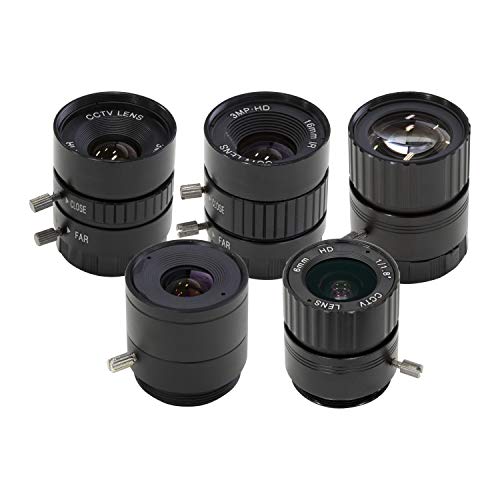
A complete starter kit designed for quick switching across focal lengths. With 6 lenses spanning 6mm to 25mm, users can select the best field of view for scenes ranging from close-ups to landscapes. Each lens is labeled with its FoV, reducing guesswork.
Best for: educators, makers, and hobbyists who want a go-to selection for multiple shooting scenarios without purchasing individual lenses.
Limitation: Boxed set means more lenses than some users need; storage and organization are recommended to maintain quick access.
Zowietek 5-50mm Zoom CS Mount Lens

Best for versatile, longer-distance work. This manual-focus, zoom CS-mount lens covers a broad focal range, suitable for applications requiring a single, adjustable lens for varied distances. It supports IMX477 and other imaging sensors commonly used with Raspberry Pi HQ cameras.
Best for: photographers and developers needing a flexible, single-lens solution for testing multiple compositions without changing hardware.
Caution: Zoom and focus controls require careful adjustment to maintain sharpness across the frame; misfocus is common if not calibrated.
Buying Guide
Key factors to consider when choosing a CS-mount lens for the Raspberry Pi HQ Camera include focal length range, manual vs. adjustable aperture, compatibility with the IMX477 sensor, and how much you prioritize ease of swapping lenses versus having a single versatile option.
- Focal length range: Short focal lengths (e.g., 3–6mm) favor wide scenes, indoor use, and close-ups. Zoom lenses (e.g., 8–50mm, 5–50mm) provide flexibility for multiple distances without changing lenses.
- Aperture control: Adjustable apertures help manage depth of field and brightness, useful in variable lighting or macro work.
- Mount compatibility: CS-mount is standard on many Raspberry Pi HQ configurations, but verify your specific camera module’s back focal length and mounting system.
- Image quality: Look for lenses tested with Raspberry Pi HQ cameras to minimize shading and vignetting.
- Physical size and weight: Heavier or bulkier lenses may affect mounting stability or require support accessories.
Frequently Asked Questions
- What does CS-mount mean for Raspberry Pi HQ Camera? – CS-mount refers to a compact lens mount standard used with many camera modules, including Raspberry Pi HQ, enabling interchangeable lenses.
- Is a zoom lens better than fixed focal length for beginners? – A zoom lens offers flexibility without swapping lenses, which can be advantageous for evolving use cases.
- Do these lenses require special software to work? – Basic usage is supported by standard camera interfaces; advanced control is typically managed through camera settings or imaging software.
- Will these lenses work with other camera modules? – Some CS-mount lenses work with other CS-mount cameras; confirm compatibility with your specific sensor size and back focus.
- Are adjustable aperture lenses worth the extra cost? – If you frequently encounter varying lighting or need precise depth of field control, adjustable aperture can be beneficial.
- How do I choose the right focal length for a project? – For tight indoor spaces or macro work, choose shorter focal lengths; for photographing distant subjects, higher focal lengths or a zoom lens is preferable.