If you frequently transfer photos and videos from cameras, drones, or memory cards to your iPhone, iPad, Mac, or PC, a reliable digital camera card reader is essential. This guide highlights five top options, detailing who each product is best for and why. Whether you’re a traveling photographer, a content creator, or a casual shooter, these readers offer plug-and-play simplicity, cross-device compatibility, and fast transfer speeds.
| Product | Best For | Key Benefit |
|---|---|---|
| Denlane SD Card Reader | Apple users and USB-C devices | Dual interface (Lightning and USB-C), Apple MFi certified |
| SZHAIYIJIN Memory Card Reader | iPhone users needing simple USB-A OTG | No app required, broad device compatibility |
| LBSC USB C SD Card Reader | USB-C devices and MacBooks | Bi-directional transfer, two-card support |
| BENFEI 4in1 USB-C/USB 3.0 Card Reader | Multi-card users and professionals | Reads four card types simultaneously |
| SXRBSSM SD Card Reader | iPhone 15/16 users | Plug-and-play, USB-C efficiency |
Denlane SD Card Reader for iPhone and USB-C Devices

Best for Apple users who also carry USB-C devices. The Denlane reader offers dual connectors—Lightning and USB-C—without requiring apps or drivers. It is designed for direct, plug-and-play transfers from SD/TF memory cards to iPhone, iPad, Mac, and USB-C laptops. This makes it ideal for photographers who shoot with traditional cameras and want quick sharing on social media or immediate archiving on iOS devices.
- Two interfaces: Lightning or USB-C. Note: They cannot be used simultaneously.
- Apple MFi certified for seamless compatibility with iPhone and iPad.
- No app, network, or power needed; just plug in and transfer.
Best for: Photographers who primarily use Apple devices and want a compact, all-in-one solution. Limitation: The two ports cannot operate at the same time, so you must choose the connection type per transfer.
SZHAIYIJIN SD Card Reader for iPhone
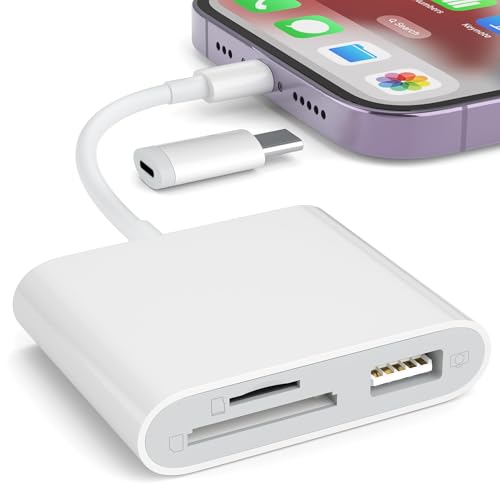
This model suits photographers who want a straightforward, app-free transfer from SD/TF cards to iPhone or iPad. It supports SD and Micro SD cards and uses a Lightning-to-USB OTG interface. It’s particularly practical for those who shoot with traditional cameras and need quick imports into iPhone Photos for editing and sharing without extra software.
- No app required; after inserting the card, use Photos to import.
- Supports SD/SDHC/SDXC and Micro SD cards; does not support Wi-Fi SD cards.
- Lightning to USB OTG interface; the USB port accepts compatible accessories within power limits.
Best for: Content creators who want a simple, no-fuss import path to iPhone or iPad. Limitation: No support for Wi‑Fi SD cards and no direct USB-C compatibility.
LBSC USB C SD Card Reader (2 Slots)
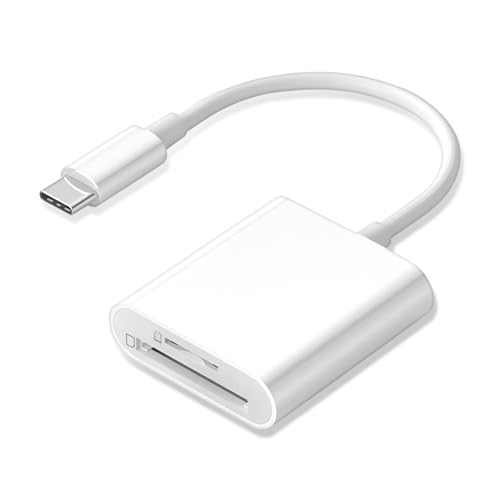
Best for USB-C devices and Mac users who want reliable, bi-directional transfers. This reader provides two slots (SD and Micro SD) and supports bidirectional transfer between memory cards and devices like iPad Pro, MacBook, and USB-C laptops. It’s a strong pick for travelers who need flexible card management on the go.
- Bi-directional transfer between cards and devices.
- Compatible with USB-C devices and Macs; supports OTG functions.
- Two-slot design enables simultaneous reading and writing on SD and Micro SD cards.
Best for: Professionals who routinely move content between multiple memory formats on USB-C platforms. Caution: Some thicker cases may prevent full card insertion.
BENFEI 4in1 USB-C/USB 3.0 Card Reader

Best for multi-card users who need fast, simultaneous access to several card types. The BENFEI reader supports SD, Micro SD, MS, and CF cards through USB-C or USB 3.0 interfaces, enabling up to high-speed transfers. It’s well-suited for editors and travelers who juggle different media formats across devices.
- Reads four card types at once: SD, Micro SD, MS, CF.
- USB-C and USB 3.0 compatibility for broad device support.
- Transfer speeds align with USB 3.0 capabilities; final speed depends on card and port.
Best for: Pros needing a single hub for multiple card formats. Limitation: Size is larger than ultra-compact readers, affecting portability for some travelers.
SXRBSSM SD Card Reader for iPhone

Best for travelers who want a plug-and-play USB-C reader tailored to iPhone 15/16 models. This reader emphasizes ease of use, immediate transfer without apps, and reliable performance with SD/TF cards. It’s a practical choice for quick backups during shoots and travel.
- 2-in-1 SD card support with USB-C compatibility for iPhone 15/16 and iPad.
- Plug-and-play; no app required.
- Direct transfer of high-resolution photos and 4K video from camera to device.
Best for: Those who want a straightforward USB-C reader with iPhone-centric compatibility. Limitation: May require using the Files app for management on some devices.
Buying Guide: Key Considerations For A Digital Camera Card Reader
- Device compatibility. Determine whether you need USB-C, Lightning, or both, and verify support for iPhone, iPad, Mac, Windows, or Android.
- Card types supported. Ensure the reader supports SD, SDHC, SDXC, Micro SD, MS, CF, or other cards you use.
- Transfer direction. Decide if you need one-way import, two-way transfer, or bulk upload capabilities.
- Plug-and-play vs. apps. Some readers require no apps, while others rely on system software; consider your workflow preferences.
- Speed and reliability. Look for USB 3.0/3.1 or USB-C speeds, and note that real-world speeds depend on card and device.
- Portability and build. Consider size, weight, and the presence of protective end caps to guard ports during travel.
- Power requirements. Some devices can draw power from the host device; others may require separate power when using high-demand cards.
FAQ
- Do these readers require software or drivers? Most listed readers are plug-and-play with no app or driver needed.
- Can I use SD and Micro SD cards at the same time? Some models support dual slots for simultaneous reading, others do not.
- Are there limits on file types or video formats? These readers generally transfer standard photo and video files; specific compatibility depends on the device OS.
- Will a reader work with both iPhone and Android devices? Many readers support a range of USB-C devices; Lightning-based readers primarily support Apple devices.
- Is a reader faster on USB-C than USB-A? Yes, USB-C and USB 3.0 connections typically offer higher transfer speeds, though actual speed depends on the card and device.
- What should I consider for travel use? Prioritize compact size, robust build, and true plug-and-play compatibility with your primary devices.