Digitizing old negatives and slides is easier than ever with standalone film scanners. This guide highlights five reliable options, each best for a different type of user—families preserving travel memories, hobbyists digitizing large collections, or seniors seeking simple, no-computer devices. All picks offer built-in LCD screens and direct-to-SD options for quick sharing. The following product summaries explain who each scanner is best for, plus practical limitations to consider before buying.
| Product | Best For | Key Benefit |
|---|---|---|
| KODAK Slide N SCAN | Best for versatile film types | Supports 135, 126, 110 slides with 5” LCD |
| DigitPro Photo Scanner | Best for all-in-one simplicity | 5” screen; handles slides, negatives, photos; no computer needed |
| DigitPro Film And Slide Scanner | Best value with broad format support | 22MP output; 5” LCD; SD/128MB built-in memory |
| DIGITNOW! 135 Film Negative Scanner | Best for quick, standalone use | 5/10 MP, rapid slide feeder; no computer required |
| Portta Film Scanner | Best for high-res options | 22MP output; HDMI and SD storage |
KODAK Slide N SCAN Film & Slide Scanner
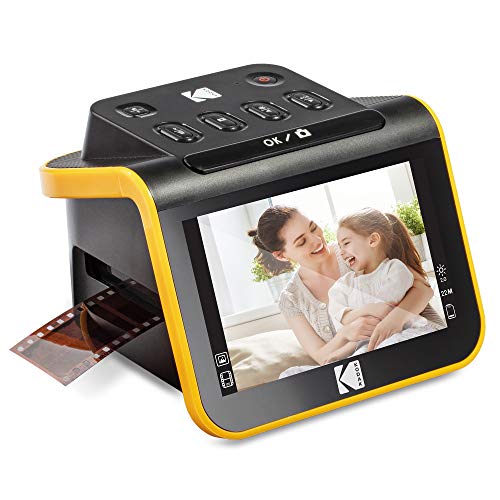
The KODAK Slide N SCAN is a 1422MP film scanner designed to convert 135, 126, and 110 negatives and slides into digital JPEGs. It features a 5” LCD display for on-device viewing and editing, and a continuous-load tray for faster scanning. It saves files to an SD card (not included) and includes adapters for multiple film formats, a cleaning brush, and USB/HDMI outputs. This model is ideal for households with mixed slide collections and for users who want a built-in screen and simple operation. A potential limitation is the reliance on SD cards not included in the package.
Best for: Families with mixed film formats who want a standalone scanner with a large display for quick previews and simple sharing.
DigitPro Photo Scanner And Film Digitizer
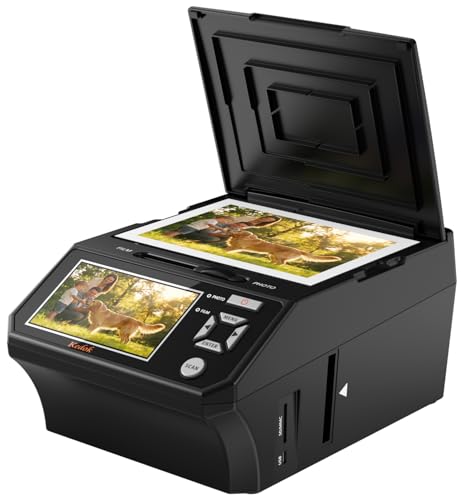
This all-in-one DigitPro scanner handles 35mm, 135, 110 negatives, slides, and even photos and business cards. It includes a 5″ screen for instant previews and requires no computer software. With an 8GB SD card and built-in memory, it’s designed for users who want a straightforward, plug-and-scan experience. It’s especially suitable for non-technical users, grandparents, or anyone digitizing smaller collections without a PC. A potential caveat is the internal storage limit and reliance on SD card capacity for larger archives.
Best for: Buyers seeking a single, no-fuss device to convert mixed media quickly and shareable results right away.
DigitPro Film And Slide Scanner – 22MP

This DigitPro model emphasizes 22MP high-resolution scans and supports 35mm/135 and 110 film, as well as slides and Super 8 film. It stores images on its internal memory or an SD card (up to 64GB, FAT32/EXFAT). The 5” LCD allows immediate review, and one-touch scanning makes it suitable for families and hobbyists who want a quick, guided workflow without a computer. A limitation to note is potential compatibility constraints with external media formats beyond listed types.
Best for: Users digitizing a broad mix of film formats who want clear, high-res results without complex setup.
DIGITNOW! 3X Magnification Slide Viewer

The DIGITNOW viewer is a portable, battery-powered slide and film viewer rather than a full scanner. It provides a 3X magnified viewing screen with built-in LED illumination for examining slides and negatives before digitizing. It’s best for quick inspection or for users who want a simple way to preview content before scanning with another device. A limitation is that it does not convert images itself; it’s a pre-scan inspection tool rather than a digitizer.
Best for: Quick on-the-spot viewing and selection before digitizing with another scanner.
Portta Film Scanner With 5″ LCD

The Portta scanner offers 16MP or 22MP output options, a 5” LCD, and no-computer operation. It scans 135, 126, 110 film, slides, and supports SD storage. With HDMI output, it can connect to external displays for easy sharing. This model is a strong pick for users wanting a higher-res scan without a PC and with HDMI-enabled viewing on a larger screen. A noted limitation is the need to choose between 16MP and 22MP modes depending on the project’s quality needs.
Best for: Users who want a higher-resolution standalone option with easy HDMI sharing capabilities.
Kedok Photo, Name Card, Slide & Negative Scanner

KEDOK blends multiple media types into a single device. It supports 35mm/110 film, slides, and name cards, saving to internal memory plus an 8GB SD card included. The 5” LCD screen makes previewing easy, and the device is pitched as a family-friendly gift. A limitation is that extended archives may require SD card expansion beyond the included 8GB, and some formats may need manual adjustments after scanning.
Best for: Families or seniors needing a versatile, visually clear, all-in-one digitizing tool with gift appeal.
DigitPro 35mm Film & Slide Scanner

This DigitPro model focuses on 35mm film and slide scanning with a 2.4″ LCD screen and TV-out capabilities for bigger viewing. It uses a quick slide feeder for continuous loading and scans to JPEG on its own, offering a compact solution for archiving large collections of 35mm slides. A limitation is the smaller display size, which may require switching to TV-out for detailed edits or reviews.
Best for: Enthusiasts digitizing 35mm slides who want a compact, standalone workflow with easy TV-out sharing.
Buying Guide: Key Considerations When Digitizing Negatives And Slides
- What formats do you need to scan? Consider whether you require support for 135, 110, 126, slides, and 8mm/Super 8 film. Some models handle a wider range than others.
- How important is a built-in display? A larger LCD makes previews easier and reduces the need to connect to a computer or TV.
- Storage options matter. Check whether the device offers internal memory and the maximum SD/SDHC/SDXC size it supports, plus whether a card is included.
- Output resolution and quality. Look for 22MP or equivalent high-resolution options if you plan to print or enlarge scans.
- Stand-alone vs. computer-dependent. If you want a PC-free workflow, choose a model explicitly designed for standalone operation.
- Ease of use. One-touch scanning, intuitive menus, and simple feed mechanisms reduce the time spent digitizing large collections.
- Portability. If you’ll digitize on the go, consider compact designs with battery options or simple power requirements.
FAQ
- Do these scanners require a computer? Some do, but several models are designed to work standalone with internal memory and SD card storage.
- What resolution should I look for? 22MP is a common high-quality target for cropping flexibility; some models offer 16MP as a more budget-friendly option.
- Can I view scans on a TV? Many scanners provide TV-out or HDMI options to view or share photos on a larger screen.
- Which formats are supported? Look for compatibility with 35mm/135, 110, and 126-film, plus slides. Some also support name cards or negatives.
- Are included SD cards enough for large archives? Larger collections may require additional SD cards with higher capacity.
- Is one device better for gift giving? Models with a large LCD, simple “one-touch” scanning, and built-in memory are ideal as gifts for family members.