If you’re expanding an EF-M system, these third-party and official adapters and lenses help you maximize compatibility and creative flexibility. The best choices below target different buyers: budget adapters for beginners, compact primes for street photography, macro options for close-ups, and official options for native compatibility. This guide highlights who each product suits and why it was chosen, plus practical caveats to consider during shopping.
| Product | Brand | URL |
|---|---|---|
| JJC EF-EOS M Auto Focus Lens Mount Adapter Converter | JJC | https://www.amazon.com/dp/B09FX17B3Z?tag=besttech085-20 |
| Fotasy PK Lens to Cannon EF-M Mount Adapter | Fotasy | https://www.amazon.com/dp/B00SUEJR0C?tag=besttech085-20 |
| Canon EOS M Mount Adapter | Canon | https://www.amazon.com/dp/B008NF8CEK?tag=besttech085-20 |
| EF-M Mount 32mm Pin-Focus Pancake Lens | Xuan | https://www.amazon.com/dp/B0CH4M4PYF?tag=besttech085-20 |
| Canon EF-M 28mm f/3.5 Macro IS STM | Canon | https://www.amazon.com/dp/B01FH4H30I?tag=besttech085-20 |
JJC EF-EOS M Auto Focus Lens Mount Adapter Converter

The JJC adapter enables EF and EF-S DSLR lenses to be used on Canon EF-M mirrorless bodies. It supports electronic communication to enable autofocus and auto exposure when paired with suitable lenses. Best for photographers seeking cost-effective compatibility with established Canon or third-party glass.
Who it’s best for: budget-conscious users who want to extend the life of existing DSLR lenses on EF-M bodies, especially for beginner to intermediate shooters. Limitations: effectiveness varies by lens; some older or non-Canon lenses may rely on manual control, and not all features may be supported depending on the lens.
Fotasy PK Lens to Canon EF-M Mount Adapter
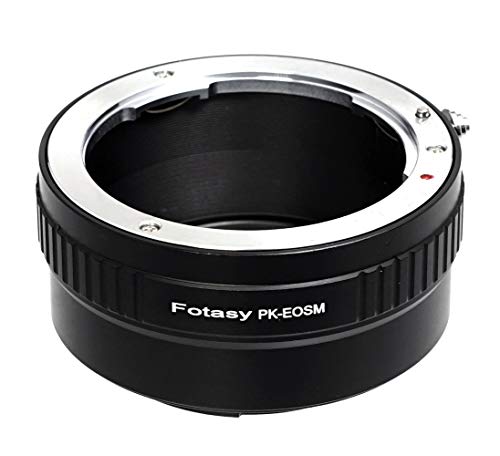
The Fotasy PK EFM adapter enables PK (Pentax K) lenses to fit Canon EF-M cameras. It guarantees infinity focus and is a simple, manual-diaphragm option. This is a practical choice for those who own Pentax or legacy lenses and want to explore EF-M bodies without new investment.
Who it’s best for: photographers with Pentax K lenses seeking a low-cost path to EF-M bodies. Limitation: no electronic communication means you’ll manually adjust focus and exposure; automatic features are not supported with this adapter.
Canon EOS M Mount Adapter

Canon’s official EOS M Mount Adapter provides native-grade compatibility for EF and EF-S lenses on Canon EF-M cameras. It is designed for reliability and seamless integration with the EOS M lineup, making it the best option when precise autofocus and exposure control are prioritized.
Who it’s best for: users who want proven compatibility and dependable performance with Canon-branded glass. Caution: price may be higher than third-party adapters, and available features depend on the lens used.
EF-M Mount 32mm Pancake Lens (Xuan)

This 32mm pancake is a compact prime for EF-M cameras with fixed aperture and no focus mechanism. It’s suited for street photography and travel where space and weight matter. Best for those who want a small, lightweight lens with no focusing complexity.
Who it’s best for: travelers and street shooters who prioritize a very compact system. Caution: fixed focus limits depth of field control; plan ahead for distance to your subject, as focus patience is required at varying distances.
Canon EF-M 28mm f/3.5 Macro IS STM

The Canon EF-M 28mm f/3.5 Macro IS STM combines macro capabilities with native EF-M mount optics. With built-in Macro Lite and a 58 mm filter size, it supports close-up detailing and versatile fieldwork. It’s a strong pick for macro enthusiasts and general-purpose street shooters seeking sharpness and close focus.
Who it’s best for: macro lovers and casual shooters who want a compact native option with macro features. Limitation: macro performance is optimized at short distances, which may constrain working distance in some subjects.
Buying Guide: Key Considerations for EF-M Lenses and Adapters
- Compatibility: Confirm whether the lens or adapter supports autofocus, exposure control, and communication with your specific EF-M camera model.
- Purpose and focal length: Choose based on use case—city/street, macro, or telephoto needs. Short primes and pancake lenses favor portability, while adapters expand lens options.
- Manual vs. electronic control: Third-party adapters may require manual focus and exposure; official Canon adapters often provide fuller electronic integration.
- Build quality and material: Aluminum and brass builds tend to be durable; consider weight if you plan long shooting sessions.
- Infinity focus and compatibility notes: Some adapters guarantee infinity focus with certain lenses; verify this for your lens lineup to avoid surprises.
- Cost vs. benefit: Official accessories may offer stronger guarantee and compatibility, while third-party options can provide budget-friendly, broad compatibility.
FAQ
- What is the main benefit of using an EF-M adapter on Canon cameras?
– It allows you to use Canon EF and EF-S lenses on EF-M bodies, expanding your lens choices without buying a whole new system. - Do third-party adapters always support autofocus?
– Not always. Some adapters support autofocus with certain lenses, while others are manual only. Check compatibility before buying. - Is there a difference between official Canon adapters and third-party options?
– Official adapters tend to offer the most seamless electronic communication and compatibility, but third-party adapters can be more affordable and versatile. - Can I use Pentax K lenses with EF-M cameras?
– With a PK to EF-M adapter, some Pentax K lenses can fit, but you’ll typically lose electronic control and must manually focus and meter. - Are macro lenses necessary for close-up work on EF-M cameras?
– Not strictly; macro-capable lenses or dedicated macro adapters enable close focusing, but some standard lenses with macro features can also provide close-up options. - Which option is best for street photographers on a budget?
– A compact pancake lens or a budget third-party adapter paired with existing lenses may offer the best balance of size, cost, and flexibility.