Answering the need for extreme perspective and dramatic distortion, these Canon-mount fisheye lenses cover EF, EF-S, and RF-Mount options. This guide helps you choose the right fisheye based on your camera type, whether you shoot on a DSLR with a Canon EF/EF-S mount or a Canon RF-mount mirrorless body using an adapter. The top picks below are selected for wide angles, simple manual control, and strong image quality. Best for creative photographers who want dramatic environments, astrophotography, or unique architectural shots.
| Product | Brand | Mount Type | |
|---|---|---|---|
| Altura Photo 8mm F3.0 | Altura Photo | Canon EF | 8mm fisheye, 180° view, manual focus |
| Meike 8mm F3.5 | Meike | Canon EF | 8mm, 200° FOV, rectangle fisheye, manual focus |
| Rokinon HD8M-C 8mm F3.5 | Rokinon | Canon EF | 8mm, 167° diagonal, manual focus |
| 7artisans 10mm F2.8 II | 7artisans | Canon RF | 10mm, 185° diagonal, manual focus |
| TTARTISAN 7.5mm F2.0 | TTARTISAN | Canon RF | 7.5mm, 180° view, F2, manual focus |
Altura Photo 8mm F3.0 Professional Fisheye for Canon EF
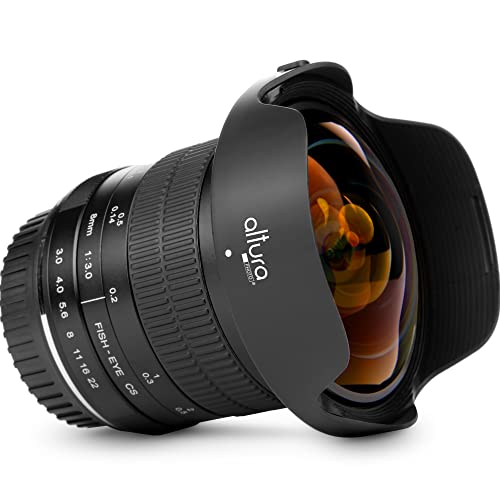
Best for Canon DSLR users with EF or EF-S mounts who want a true circular 180° field of view. This manual-focus lens features a removable hood for dramatic 180° views and a solid metal build. Not compatible with Canon mirrorless cameras unless using an adapter. Ideal for landscape, architecture, and experimental photography where extreme distortion is desired.
Best for: photographers who want a budget-friendly, durable fisheye with a strong, consistent 180° frame on Canon DSLRs. Caution: results vary on full-frame bodies and may show circular imagery with vignette on certain formats.
Meike 8mm F3.5 Ultra Wide Angle Fisheye

Best for enthusiasts seeking a compact, manual focus fisheye with a wide 200° field of view on Canon EF-mount cameras. The lens delivers dramatic perspective with a notable close focusing distance. It is best used on APS-C bodies to maximize the distortion effect. Limitation: manual focus only, and performance depends on camera settings and sensor size.
Rokinon HD8M-C 8mm F3.5 Fisheye

Best for photographers seeking a dramatic ultra-wide 8mm fisheye with manual focus and a high-quality construction. It delivers a 167° diagonal field of view and yields strong distortion for creative imagery. Notable limitation: the full-frame coverage requires acknowledgment that full-frame bodies will show a circular image with vignette on certain setups.
7artisans 6mm F2.0 Fisheye for Canon RF

Best for RF-mount Canon mirrorless shooters who want a 220° ultra-wide view. The fast F2.0 aperture supports low-light scenes and astrophotography. Best for: creative night photography, landscapes, and dramatic close-ups with strong distortion. Caution: manual focus only, and adaptor considerations apply if pairing with non-RF bodies.
TTARTISAN 7.5mm F2 Fisheye RF Mount

Best for Canon RF-mount users who want a true 180° fisheye on APS-C bodies. The fast F2 aperture aids astrophotography and low-light imaging, while the 180° diagonal angle offers immersive perspectives. Choose this if you prioritize a low-light advantage and full-frame-ready optic for RF bodies. Limitation: designed for RF-mount; compatibility with EF bodies requires adapters and may affect performance.
Buying Guide
What to consider when choosing a Canon-mount fisheye lens
- Camera compatibility: Determine whether your camera uses Canon EF/EF-S (DSLR) or Canon RF (mirrorless). Some lenses are designed strictly for RF-mount and may require adapters for EF bodies.
- Field of view: Fisheye lenses typically offer 180° or more. 180° diagonals are common on APS-C sensors, while some lenses provide around 167° to 185° diagonals. For dramatic distortion, wider angles are preferable.
- Aperture and low-light: Wider apertures (F2.0–F3.5) improve low-light performance, especially for astrophotography. However, many fisheyes are designed primarily for distortion rather than light gathering.
- Focus mechanism: Most listed lenses are manual focus. Consider whether you’re comfortable with manual focus in live shooting conditions or prefer quicker auto-focus (if available in a compatible version).
- Build and weight: A metal build offers durability for outdoor shooting. Weight varies; lighter models are easier to carry for field work.
- Image circle on full-frame: Some fisheyes designed for APS-C or Canon EF-S may vignette or appear circular on full-frame bodies. Check whether you want full-frame coverage or intentional circular framing.
FAQ
- What is a fisheye lens best used for on Canon cameras? – Fisheye lenses create extreme distortion, great for creative landscapes, architecture, star trails, and immersive panoramic effects.
- Do I need an adapter to use RF-mount fisheyes on an EF body? – Yes, adapters exist, but compatibility and performance will vary; some lenses are designed strictly for RF-mount.
- Can I achieve similar distortion with standard ultra-wide lenses? – Ultra-wide lenses may produce less distortion and more natural lines; fisheyes maximize curvature and perspective exaggeration.
- Are manual focus fisheyes harder to use? – They require careful focusing, especially in low light; some models include scale marks and easy-to-use focus rings to assist.
- Which lens provides the widest angle for Canon RF bodies? – RF-mount fisheyes such as 7artisans and TTARTISAN 7.5mm variants typically offer 180° to 185° diagonals on APS-C sensors.
- Is circular imaging always a disadvantage? – Not always; some photographers purposefully choose circular images for creative, vignette-rich effects.