Global shutters excel at capturing fast-moving subjects without the rolling-shutter distortion that can blur motion. The following selection highlights five cameras that deliver true global shutter performance in compact USB formats, making them suitable for robotics, industrial vision, VR, and indie cinema workflows. Each model emphasizes high frame rates, reliable image quality, and glass-clear optics to help you assess action with minimal artifacts. This guide compares features, compatibility, and practical use cases to help you choose the right device for your projects.
| Product | Brand | Notable Feature |
|---|---|---|
| ELP Wide Angle Global Shutter Camera | ELP | 2MP, 90fps, 120° distortion-free lens |
| ELP 1080P 90fps Global Shutter Webcam | ELP | 5–50mm varifocal lens, AR0234 sensor |
| SVPRO Dual-Lens Global Shutter USB Camera | SVPRO | Dual M12 lenses, 1200P at 60fps |
| IFWATER Global Shutter USB Camera | IFWATER | 1200P at 90fps, 126° distortion-free lens |
| Magnolia | 1200P at 90fps, 200° fisheye lens |
ELP Wide Angle Global Shutter Camera

The ELP wide-angle model uses a global shutter sensor to eliminate rolling artifacts when capturing fast-moving subjects. It records at 2 megapixels with a resolution of 1920×1200 and supports up to 90 frames per second, offering smooth motion that’s essential for high-speed action sequences. The camera’s 120-degree wide, distortion-free lens broadens the field of view, which is especially useful for situational awareness in robotics, industrial inspection, and dynamic live shoots. At a compact 38mm x 38mm board size, it can slot into tight enclosures or embedded setups with ease.
In practice, the combination of a global shutter and a high frame rate helps preserve detail when objects zip past the frame. The sensor’s Aptina AR0234 platform contributes to crisp, clean imagery in varying lighting conditions, making it a dependable choice for USB capture into consumer workstations or embedded systems. The device’s wide field of view is balanced by relatively low distortion, providing consistent perspective across different shooting angles. For users building a compact vision system, this model offers a strong blend of performance and installability.
Installation flexibility is another plus. Its small footprint and straightforward USB interface keep integration simple in both desktop and industrial environments. While the camera emphasizes speed and accuracy, it remains approachable for hobbyists and professionals who want reliable global shutter performance without a complex setup. If your project involves fast-moving subjects and requires a wide but controlled field of view, this camera is worth evaluating as a core module in your imaging stack.
ELP 1080P 90fps Global Shutter Webcam

This ELP model emphasizes a manually adjustable zoom and focus, delivering a versatile solution for desktop setups and mobile rigs. Its 2MP sensor delivers 1920×1200 resolution at up to 90fps, enabling crisp playback of fast action. The 5–50mm varifocal lens allows on-the-fly framing adjustments, which is valuable for product demonstrations, close-ups in tutorials, or sports coaching shots where you need to reframe quickly without swapping lenses.
The sensor’s global shutter capability keeps subjects sharp when light changes occur or objects move rapidly across the frame. The flexible lens system supports a variety of distances, helping operators tailor depth of field and perspective without disassembling equipment. On projects requiring precise timing and reliable video, the combination of high frame rate and variable focus makes this camera a practical choice for creative workflows and time-sensitive captures.
As with other USB cameras in this segment, compatibility with common operating systems and software libraries ensures straightforward integration. It’s suitable for live-streaming setups, machine-vision experiments, or training sessions where consistent motion capture enhances analysis. While it may not match cinema-grade color science in every scenario, its speed, adjustability, and compact form factor offer a compelling balance for rapid production environments.
SVPRO Dual-Lens Global Shutter USB Camera

The SVPRO dual-lens camera combines two M12 lens modules with a synchronized global shutter sensor, delivering a 1200P capture at 60fps. The dual-lens setup allows synchronized stereo-like imaging, which is advantageous for depth perception in robotics, VR testing, or 3D measurement tasks. The inclusion of a global shutter minimizes motion artifacts when both lenses track fast-moving subjects or rapidly changing scenes, yielding more stable data streams for analysis, modeling, and validation in research and industrial contexts.
Image quality is supported by an 85-degree low-distortion viewing angle, helping to maintain realistic perspective without aggressive rectification needed in post. The device operates across Windows, Linux, Android, and macOS, enabling broad software compatibility for vision pipelines, interactive installations, or imaging experiments. This model is well-suited to teams that require simultaneous capture from two perspectives without compromising synchronization or latency.
Practical deployments include robotic navigation tests, machine-vision training, or augmented reality demonstrations where depth cues improve user experience. Its USB plug-and-play approach reduces the time to prototype, while the robust global shutter performance guards against blur in high-speed scenes. If your project benefits from stereo-like data streams and consistent frame timing, this SVPRO model provides a compelling balance of capability and ease of integration.
IFWATER Global Shutter USB Camera

IFWATER presents a 90fps capable 1200P USB camera with a 126-degree distortion-free lens, delivering a broad field of view that remains geometrically accurate. Built around a 2MP AR0234 color global shutter sensor, the device targets fast-action scenarios where timing and clarity matter. The compact 38x38mm module design supports embedded projects, laser systems, or laptop-based workflows where space is at a premium but performance cannot be compromised.
In practice, gains come from the combination of global shutter and a wide lens with relatively low distortion. This makes it suitable for applications like golf-swing analysis, industrial automation, or rapid prototyping experiments where the camera needs to cover a wide scene without introducing distortion that would complicate measurements. Its USB interface simplifies integration with common development boards and PCs, allowing researchers and engineers to run computer-vision experiments with minimal setup.
Users benefit from the balance between resolution, frame rate, and lens coverage, which supports both real-time monitoring and post-processing analysis. The IFWATER module can be deployed in educational labs, robotics kits, or manufacturing lines where a reliable, distortion-controlled wide view is essential to capturing every critical moment in fast-moving operations.
Magnolia Global Shutter USB Camera Module
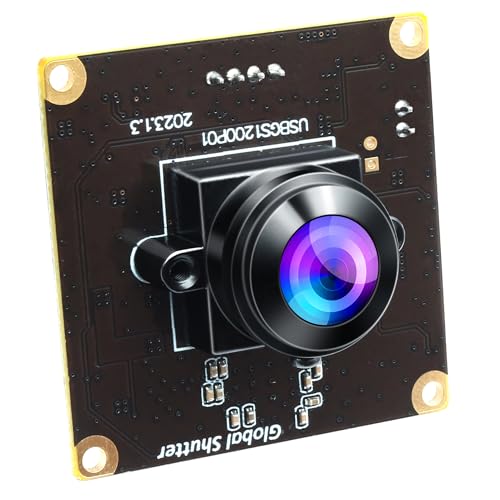
Magnolia’s camera module centers on a 1200P resolution at 90fps with a wide 200-degree fisheye lens. The global shutter technology ensures motion clarity across fast-paced scenes, making it a strong option for drone navigation, industrial inspection, or immersive VR testbeds. The combination of a high frame rate and a fisheye lens expands scene coverage dramatically, enabling a holistic view of complex environments while keeping motion artifacts at bay.
Because of the 200-degree fisheye, image data can require distortion correction in post if precise geometry is necessary. Magnolia’s approach suits applications where full-sphere coverage is advantageous, such as panoramic capture, wide-area surveillance, or certain robotics simulations that rely on expansive situational awareness. The 2MP sensor is adequate for many machine-vision tasks, delivering reliable performance without overwhelming data bandwidth in embedded or USB-connected systems.
For developers who prioritize a large field of view and fast capture rather than ultra-telecentric precision, Magnolia’s module enables rapid prototyping and testing. It’s also a good fit for education and research where students can explore global shutter concepts, wide-angle optics, and synchronization in a compact, easy-to-handle package that integrates with standard USB-based workflows.
QILOVE 1200P Global Shutter USB Camera

QILOVE combines a 4.0-megapixel sensor with a global shutter, delivering 3200x1200p at 60fps and a robust 120fps at 1600×600 resolution. The kit includes a dual-lens M12 design with a distortion-free, wide field-of-view (HFOV 112 degrees). This makes the camera particularly well-suited for robotics, 3D measurement, and VR applications where precise motion capture and synchronized perspectives are essential. The dual-lens arrangement enables richer spatial data that improves tracking and scene understanding in real time.
The camera emphasizes a distortion-free experience with no rolling artifacts. The broad frame rate options allow for smooth slow-motion capture and rapid real-time analysis, enabling a range of workflows from high-speed industrial testing to immersive AR demonstrations. The modular, dual-lens configuration supports experiments that require multiple viewpoints without the complexity of external synchronization hardware. It is a practical option for teams exploring advanced computer vision tasks in research or production settings.
For engineers and researchers, the QILOVE model provides a compelling balance of high resolution, fast frame rates, and synchronized dual lenses. It’s particularly effective in applications where precise timing and coherent multi-view data drive better insight, such as autonomous navigation studies, depth estimation projects, and complex motion tracking experiments that benefit from simultaneous multi-angle capture.
Buying Guide
Key Purchase Considerations
- Global shutter capability: Confirm that the sensor architecture truly avoids rolling artifacts at your target frame rate and resolution. This is essential for fast action and rapid lighting changes.
- Resolution and frame rate: Match your project needs. For fast motion, prioritize higher fps (60–90fps) at a resolution that your workflow can handle without excessive data load.
- Lens and field of view: Wide-angle or fisheye lenses expand coverage but may introduce distortion. Check whether distortion correction is available in software or hardware, and whether you can swap lenses (M12 compatibility often helps).
- Interface and compatibility: USB interfaces are convenient for desktops, laptops, and embedded systems. Verify driver support and compatibility with your OS, SDKs, and vision libraries (OpenCV, ROS, etc.).
- Physical size and integration: Look for compact modules if you’re embedding cameras into rigs, drones, or enclosures. Consider mount points and power requirements when integrating with other hardware.
- Color science and image quality: Some cameras emphasize low-noise performance or color fidelity. If you’re doing post-production or color grading, consider how the camera’s raw output or ISP processing fits into your pipeline.
- Synchronization and multi-camera setups: Dual-lens or multi-sensor configurations benefit from precise timing and alignment. Check whether the units support simultaneous capture and whether any external sync signals are required.
- Durability and reliability: For industrial or field use, evaluate heat management, build quality, and long-term availability of the sensor and components.
Product Comparisons
| Product | Max Resolution | Frame Rate | Lens / FOV | Best For |
|---|---|---|---|---|
| ELP Wide Angle Global Shutter Camera | 1920×1200 (2MP) | 90fps | 120° wide, low distortion | High-speed action, embedded applications |
| ELP 1080P 90fps Global Shutter Webcam | 1920×1200 | 90fps | 5–50mm varifocal | Flexible framing, desktop to portable rigs |
| SVPRO Dual-Lens Global Shutter USB Camera | 1200P | 60fps | Dual M12 lenses, 85° FOV | Stereo capture, depth sensing |
| IFWATER Global Shutter USB Camera | 1200P | 90fps | 126° distortion-free | Wide coverage, embedded projects |
| 1200P | 90fps | 200° fisheye (distortion-corrected) | Panoramic and immersive testing |
When choosing among these options, consider your primary use case: fast action capture in constrained spaces, multi-angle depth sensing, or expansive field-of-view demonstrations. If you need precise dual perspectives for depth data, a model like the SVPRO dual-lens camera can simplify your pipeline. For immersive simulations or panoramic sensing, Magnolia’s 200-degree fisheye provides a dramatic perspective, though you may need distortion correction in software. For compact, high-speed desktop workflows, ELP’s wide-angle or adjustable-zoom options deliver strong performance without heavy hardware requirements.
In all cases, verify field testing in your environment before committing. Environmental lighting, motion dynamics, and the type of subjects you shoot influence perceived quality as much as sensor resolution and frame rate. If possible, request sample footage or test units to evaluate latency, USB bandwidth usage, and the effectiveness of any built-in stabilization or calibration tools. A well-chosen global shutter camera should integrate smoothly with your existing pipeline, deliver reliable performance during critical moments, and offer predictable results across sessions and users.