Finding the right high speed video camera depends on intended use and environment. This guide highlights five strong choices for American buyers, spanning monochrome and color sensors, USB, HDMI, and variable focal length lenses. Whether you’re capturing ballistic trajectories, mechanical vibrations, or fast action at 4K, these models are picked for reliability, data throughput, and suitability for different setups such as Windows, Linux, macOS, or Raspberry Pi integrations. This overview helps buyers compare features side by side and chooses the best fit for specialized capture tasks.
Buyer summary at a glance. The table below outlines key facets to compare quickly: camera name, sensor type (color or monochrome), max resolution/frame rate, primary output interfaces, and ideal use case.
| Product | Sensor Type | Max Resolution/Frame Rate | Output | Best For |
|---|---|---|---|---|
| QILOVE Global Shutter USB Camera | Monochrome | 160×120 @ 640fps | USB | High-speed motion analysis, machine vision |
| IFWATER 4K 60fps High Speed Camera | Color | 4K/60fps | USB3.0 + HDMI | Professional streams and conferencing |
| ELP High Speed USB Zoom Camera | Color | 1080P @ 230fps; 4K @ 60fps | USB3.0 | Detailed close-ups, macro-like action |
| HTENG VISHI High Speed USB3.0 Camera | Color | 790fps (low-res) | USB3.0 | Fast transfer, basic industrial use |
| MWIRB 8K Video Camera | Color | 8K @ 15FPS | Wi-Fi, USB | Ultra-high-resolution capture for vlogging |
QILOVE Global Shutter USB Camera — 800P Monochrome High Speed

This monochrome USB camera uses a global shutter to deliver crisp, smear-free images at very high speeds, ideal for precise motion analysis. It supports 160×120 up to 640fps with 120/210/420fps modes, making it suitable for ballistic tracking, fluid dynamics, and mechanical vibration studies. The 2.8-12mm CS-mount varifocal lens adds flexibility for field of view and focus in varied machine-vision settings. Best for researchers or technicians who need distortion-free imaging of rapid events in controlled lighting.
Who it’s best for: labs, engineering teams, and automation researchers needing reliable high-speed, monochrome imaging with a global shutter. Why selected: excellent high-speed frame rate range, clear monochrome contrast, and a versatile manual lens for closeups and wide views. Caution: low pixel area at extreme fps may limit fine detail capture in very small targets.
Key considerations:
– Global shutter eliminates rolling shutter artifacts, improving accuracy in fast moves.
– Monochrome sensor boosts sensitivity and contrast in challenging lighting.
– CS-mount 2.8-12mm lens provides adjustable focal length but may require careful setup for optimal calibration.
IFWATER 4K 60fps High Speed Camera USB3.0 & HDMI Dual Output

This camera provides dual simultaneous output via HDMI and USB3.0, delivering 4K at 60fps for both interfaces. It supports three working modes: USB-only, HDMI-only, or USB+HDMI, which is convenient for live monitoring and archival capture. A 3X manual optical zoom lens (3.6-10mm) with a 1/2.8-inch sensor enables precise framing and exposure control for professional presentations, industrial demonstrations, or classroom deployments. Best for studios, labs, or fieldwork requiring flexible in/out options.
Who it’s best for: professionals who need 4K clarity with reliable live streaming or display on external monitors. Why selected: versatile output configuration and a robust lens for adaptable shot composition. Caution: user setup may be more involved due to multiple output modes and lens ergonomics.
Key considerations:
– 4K at 60fps assures high-detail recording and smooth playback.
– HDMI and USB3.0 outputs extend compatibility with many devices.
– The lens is manual zoom; consider ease of zooming during dynamic scenes.
ELP High Speed USB Zoom Camera — 1080P/230fps

This camera balances high frame rate with a practical resolution, offering up to 1080P at 230fps and 4K at 60fps. It uses a 3.6-10mm manual zoom lens for close-up clarity and adjustable field of view, making it suitable for fast-action demonstrations, lab experiments, or streaming scenarios where details at different distances matter. Best for: educators, researchers, and technicians who need rapid motion capture with adjustable focal length.
Who it’s best for: those needing strong slow-motion detail at high frame rates with straightforward setup. Why selected: strong high-speed performance combined with a versatile, manually adjustable lens. Caution: color accuracy and low-light performance may vary by scene; ensure sufficient lighting for the highest frame rates.
Key considerations:
– High-speed capture at 230fps supports detailed analysis of rapid events.
– 4K at 60fps provides Ultra HD options for future-proofing.
– Manual lens requires careful focusing during live motion to maintain sharpness.
HTENG VISHI High Speed USB3.0 Color Camera

This color machine-vision camera emphasizes fast data transfer and practical workflow for industrial usage. It lists a high transfer speed and an SDK to support development and integration, with external trigger and flash capabilities for synchronized imaging. Best for: automation setups, robotics, and inspection lines where fast capture and reliable data communication are required. Limitation: exact maximum resolution is not specified beyond general fast frame rates, so evaluate compatibility with your processing pipeline.
Who it’s best for: engineers and integrators who need straightforward data access and automation hooks. Why selected: strong emphasis on speed, SDK support, and trigger/flash options. Caution: verify software compatibility with your existing systems before purchase.
MWIRB 8K Video Camera — Ultra HD Vlogging
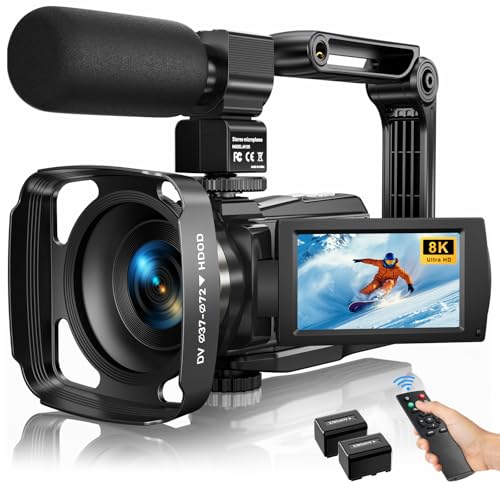
This camera targets ultra-high-resolution capture with 8K video at 15fps and 88MP images, plus 18X digital zoom and built-in stabilization. It also features remote control and Wi-Fi sharing capabilities, designed for content creators and vloggers who require flexible self-recording options. Best for: creators and teams needing high-resolution options and remote operation for solo shoots. Limitation: 8K at 15fps may not suit fast-action scenes where higher frame rates are essential.
Who it’s best for: videographers seeking extreme resolution and mobile-friendly workflows. Why selected: impressive resolution options, stabilization, and remote control. Caution: higher resolution can demand more storage and processing power; plan for adequate bandwidth and memory.
Buying Guide: How To Choose a High Speed Video Camera
What will you record most often? If you need distortion-free captures of rapid motion, a monochrome, global shutter model often yields cleaner results than color sensors in bright, fast environments. For general fast motion and streaming, color cameras with high FPS at 1080p or 4K may be more versatile.
- Output interfaces: Choose USB3.0 for PC integration, HDMI for monitors or live streaming, or dual HDMI/USB where available to simplify workflows.
- Lens options: Varifocal or manual zoom lenses provide flexibility for distance and framing. Consider compatibility with your mount and sensor size (CS mount is common for many industrial cams).
- Frame rate vs. resolution: Higher fps often comes at the expense of resolution. Define your priority: ultra-slow motion detail or high-resolution context.
- Lighting: Monochrome sensors perform better in low light; color sensors require adequate lighting to maintain color accuracy at high speeds.
- Software and SDK: If automation or integration matters, ensure the camera provides an SDK or drivers compatible with your development environment (Windows, Linux, macOS, or Raspberry Pi).
Common Scenarios and Recommendations
- Ballistic or fluid dynamic analysis: QILOVE or similar monochrome cameras with global shutter are preferable for clarity and artifact-free imagery.
- Professional live streaming or conferencing: IFWATER with dual HDMI/USB3.0 output offers flexible display and recording options.
- Close-up action and macro-like shots: EL P or HTENG VISHI models with zoom capability provide precise framing at varied distances.
- Ultra-high resolution footage for content creation: MWIRB 8K camera delivers extraordinary detail and creative control, albeit at higher data demands.
FAQ
- What is a global shutter, and why does it matter for high-speed video? A global shutter captures all pixels simultaneously, reducing motion artifacts and distortion in fast-moving subjects.
- Do these cameras require special software to function? Most provide necessary drivers or SDKs for Windows, Linux, macOS, or Raspberry Pi, but check compatibility with your workstation.
- Is 4K at 60fps always available on high-speed cameras? Not universally; some models offer 4K at 60fps while others focus on higher fps at lower resolutions. Verify the target resolution and frame rate per model.
- Can USB and HDMI output be used at the same time? Some models support dual output, enabling live monitoring while recording, which is useful for presentations and demonstrations.
- What lighting is best for high-speed monochrome cameras? Bright, even illumination minimizes noise and helps achieve higher frame rates with crisp monochrome detail.
- Are higher resolutions always better for fast motion? Not necessarily; for truly fast events, higher fps with stable lighting and proper exposure may be more valuable than maximum resolution.