Looking for an easy, stand-alone way to turn old slides, negatives, and printed photos into modern digital files? This guide reviews top image restoring digital slide converters ideal for preserving family memories. The best options vary by screen size, storage, and whether you want to scan with or without a computer. The following picks are suited for different needs: compact portability, large-screen viewing, and battery-powered convenience for on-the-go digitizing.
| Product | Best For | |
|---|---|---|
| KODAK Slide N SCAN | Home gallery enthusiasts | 5” LCD for immediate preview and editing |
| DigitPro 5” Photo Scanner | Simple, all-in-one scanning | Large 5” screen, no computer needed |
| DigitConvert Mobile Film Scanner | On-the-go digitizing | Smartphone app for instant conversion |
| DIGITNOW! 135 Film Scanner | Bulk scanning | Rapid feeder, no computer required |
| HP Touch Screen Film & Slide Scanner | High-quality, easy use | 7″ touchscreen with 13 MP sensor |
KODAK Slide N SCAN Film & Slide Scanner

The KODAK Slide N SCAN is a stand-alone film and slide scanner that supports 135, 126, and 110 formats. It converts negatives and slides into 22 MP JPEG files and saves directly to an SD card (not included). The built-in 5” LCD display provides a large preview, making it ideal for households that want to view and edit memories on a single device. This model is best for home archivists who prefer an all-in-one solution with gallery-style viewing.
Best for: Families and scrapbookers who want a dedicated, easy-to-use scanner with a larger viewing screen for quick on-device edits and slideshow-style sharing. It’s a solid choice when you value a self-contained workflow without a computer connection.
Limitations: SD card not included; workflow depends on compatible memory cards and basic post-processing on-device.
DigitPro 35mm Film & Slide Scanner

The DigitPro 35mm film scanner is designed for direct, standalone use, converting 135 negatives and slides into digital JPEGs. It features a 2.4″ LCD for on-device viewing and supports viewing in color, black-and-white, and positive modes. It’s designed for quick archiving of smaller collections with a compact footprint. The device emphasizes a simple, computer-free workflow and can output via USB for transfer to other devices.
Best for: Users who want a compact, no-fuss scanner that can digitize a small to medium stack of 35mm slides and negatives without a computer. The built-in display is helpful for immediate checks before saving to SD or USB.
Limitations: Smaller screen may be harder to inspect fine details; slower throughput on large collections due to standalone operation.
DigitConvert Mobile Film Scanner for 35mm Slides

The DigitConvert Mobile Film Scanner is a portable, battery-powered option that digitizes 35mm slides and 135 color or black-and-white film using a companion smartphone app. It emphasizes mobility and ease of use, making it a practical choice for travelers or casual users who want to digitize on the go. The included app streamlines the conversion process and supports quick editing after capture.
Best for: Individuals who need a highly portable solution and are comfortable using a smartphone app for digitization. It’s a good fit for preserving a few boxes of slides while traveling or away from a desktop setup.
Limitations: Relies on a smartphone app; higher-volume scanning may be slower and require more manual steps compared to bigger, dedicated scanners.
DIGITNOW! 135 Film Negative Scanner

The DIGITNOW! 135 Film Negative Scanner offers a rapid slide feeder for bulk scanning and outputs to an SD card up to 32GB. It supports 1800 DPI resolution and can transfer data via USB 2.0, with a video-out option to TV via NTSC/PAL. It’s a straightforward, standalone option for users with considerable slide and negative collections who want to digitize efficiently.
Best for: People who want a high-throughput, stand-alone device to convert a large number of 35mm slides and negatives with minimal setup. It’s suitable for home offices and small archival projects.
Limitations: Higher DPI does not automatically guarantee superior results on all originals; setup and feeder alignment can affect throughput for very old or curled slides.
DigitPro Photo Scanner with 5” Screen
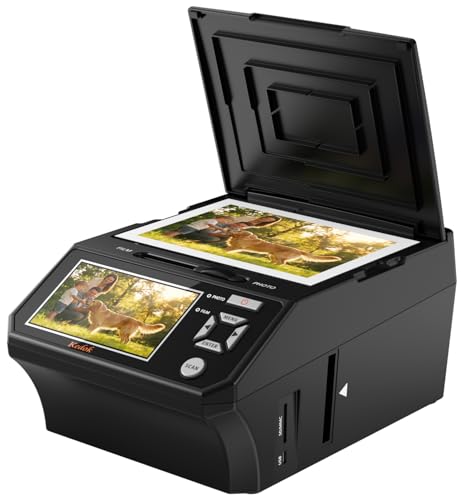
The DigitPro Photo Scanner includes a 5” LCD screen for viewing 35mm slides, 110 and 135 negatives, and printed photos. It outputs to SD with no computer required, and it supports various photo sizes including 3R to 7R through its all-in-one design. This model emphasizes a large display and a broad media compatibility, making it a versatile at-home digitizing station.
Best for: Families that want a broad media handling capability with a large built-in screen for immediate checks, editing, and sharing. It’s suitable for converting a mixed archive that includes slides, negatives, and physical photos.
Limitations: The device relies on SD card storage; users should plan for card capacity during large projects.
Buying Guide: Key Factors to Consider
- Storage and transfer: Decide between SD/USB storage or direct computer transfer. Some units save directly to SD cards without a PC, while others support USB or HDMI output for editing on a larger screen.
- Screen size: A larger built-in display helps with on-device editing. If you plan to do frequent checks, aim for 5” or larger.
- Media compatibility: Check whether the scanner supports 35mm, 110, 126, slides, prints, or mixed media. Consider future needs if you plan to archive diverse formats.
- User interface: A straightforward, button-driven interface is easier for non-tech users. Some models offer touchscreens, while others rely on physical controls.
- Standalone vs. computer-dependent: If you want a computer-free workflow, choose devices marketed as standalone or “no software required.”
- Resolution: Higher megapixel output doesn’t guarantee perfect results on all originals. Evaluate whether your priority is digital archiving efficiency or final print quality.
Frequently Asked Questions
- What is the best option for a large slide collection?
- Do these scanners require a computer at all?
- Is a larger screen always better?
- Can I scan prints along with slides?
- What should I buy if I want portability?
- Do these devices improve with a higher DPI?
Consider scanners with rapid feeders and SD card storage, such as the DIGITNOW! model, which provides bulk scanning without a computer.
Many models are standalone, saving directly to SD cards. Others offer simple PC or TV-out connections for easy viewing on a larger screen.
A larger screen helps with on-device editing and preview accuracy, but overall scanning speed and media compatibility are also important.
Some devices support printed photos in addition to slides and negatives, but confirm print size support and color fidelity beforehand.
A compact, battery-powered model with a smartphone app can be ideal for traveling and quick digitizing sessions.
Higher DPI can improve detail for certain originals, but it may not overcome issues like curl, dust, or color fading inherent in older media.