When choosing a leveling base, aim for solid stability, precise angle control, and broad compatibility with common tripod systems. These five options are well-suited for macro work, panoramic shoots, and video where uneven ground or gusty conditions threaten level framing. This guide helps buyers pick the right base for their gear and use case, from compact travel setups to pro-level rigs. The top picks below are organized to aid quick comparison and clear decisions for different photography styles.
Quick product comparison
| Product | Best for | Key benefit | Weight / Size |
|---|---|---|---|
| NEEWER LP64 Leveling Base | Macro and panoramic shooters | Three wheels with +/-5° adjustment, three bubble levels | Lightweight aluminum |
| Koolehaoda 62mm Half Ball | All-around dynamic shooting | Stable 15° tilt, 360° rotation with CNC accuracy | All-metal construction |
| Leftfoto Leveler | Video and field work | Three dials with locking rings for finger-tip precision | 3/8″ top stud, broad compatibility |
| K&F CONCEPT Leveling Base | Macro and panoramic | Three wheels, +/-5°, durable aluminum | Compact, lightweight |
| Koolehaoda ∅66mm Half Ball | 360° panos | -15° to +15° tilt, 360° swivel | 66mm half-ball platform |
NEEWER LP64 Tripod Leveling Base

The NEEWER LP64 leveling base offers precise angle control with three independent wheels and a ±5° range. It includes three built-in bubble levels to confirm alignment in multiple orientations, aiding both photography and videography on uneven surfaces. The base uses a standard 3/8″ mounting screw on top and a bottom 3/8″ thread compatible with tripods, sliders, and monopods, with a 1/4″ to 3/8″ adapter for broader use. Best for: macro shooters and panoramists who need reliable micro-adjustments. Caution: ensure the attached head or plate has a compatible quick-release system to avoid binding during adjustment.
Koolehaoda 62mm Half Ball Leveling Base

This all-metal leveling base features a 62mm half-ball platform and supports 360° rotation with a 15° tilt in any direction. Built-in bubble level helps with quick balance, and the top 1/4″-3/8″ mounting screw accommodates cameras, camcorders, and video heads. The base is designed for strong locking via an L-shaped hex key and hex screw for added stability. Best for: versatile outdoor and studio setups requiring precise three-dimensional leveling. Caution: the 15° tilt limit may be insufficient for some low-angle macro angles.
Leftfoto Tripod Leveler Stand

Leftfoto’s Leveler Stand emphasizes construction stability and precise alignment with three adjustment dials and locking rings. It uses 3/8″ top stud and bottom sockets to fit a wide range of tripods. Built for flexibility, it accommodates devices like field monitors and LED lights as part of a compact shooting rig. Best for: video and field work where quick, repeatable leveling is essential. Caution: longer setups may require additional counterweights on windy days to maintain balance.
K&F CONCEPT Leveling Base
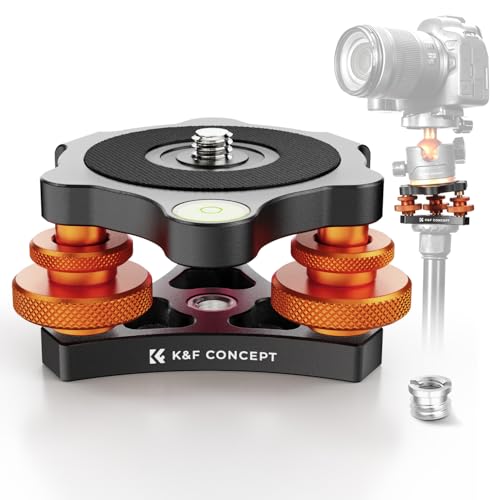
K&F CONCEPT offers a compact leveling base with three wheels and a ±5° range. It is built from aerospace-grade aluminum, delivering a strong yet light platform fit for macro work or panoramic shooting. A three-bubble-level setup helps maintain precise alignment. Best for: photographers seeking a lightweight yet capable base with travel-friendly dimensions. Caution: verify compatibility with your specific tripod head to prevent interference with existing components.
Koolehaoda ∅66mm Half Ball Leveling Base

This 66mm half-ball base supports a wide tilt range of -15° to +15° and a full 360° pan, making it ideal for expansive panorama shooting and dynamic angles. The locking knob and hex-key tightening option provide robust immobilization. Best for: outdoor travel photographers who need flexible orientation control. Caution: larger half-ball bases may add bulk to compact travel kits.
Buying Guide
Key factors to consider when choosing a leveling base:
- Angle range: Decide between ±5° for fine micro-adjustments or wider tilts up to 15° for aggressive angles.
- Mounting compatibility: Confirm top and bottom mounting threads (3/8″ and 1/4″) to match your tripod head and camera.
- Bubble levels: Multiple levels simplify quick leveling on uneven surfaces.
- Material and build: All-metal or CNC-machined aluminum bases offer durability; weight varies by model and kit.
- Weight capacity: Ensure the base can support your camera plus accessories without sag or wobble.
- Size and portability: Consider travel needs; lighter bases suit mobile setups, heavier bases stabilize larger rigs.
- Locking mechanisms: Dials and locking screws should hold position reliably during movement or wind.
Practical questions to ask before buying
- Will the base fit my existing tripod head and quick-release plate?
- Do I need 360° rotation or primarily vertical tilt for my shoots?
- Are there any compatibility issues with accessories like monitors or gimbals?
- Is there a risk of mechanical play in the detent system over time?
Usage tips
- When shooting on uneven ground, level the base first, then fine-tune with the hinge or wheels.
- Use bubble levels as a reference across multiple axes to minimize tilt errors.
- For macro work, keep the setup compact to reduce vibration; tighten all screws securely after positioning.
FAQ
- What is a tripod leveling base used for? It provides precise tilt and pan adjustments to keep the camera level on uneven surfaces, improving framing for macro and panoramic shots.
- What angle range should I prioritize? A ±5° range works well for most macro and landscape scenarios; broader ranges like ±15° suit dynamic panoramas.
- Do I need bubble levels on the base? Yes, built-in bubble levels help quickly verify level alignment in multiple directions.
- Can leveling bases support heavy camera setups? Choose bases with adequate weight capacity for your gear; higher-load models are better for professional rigs.
- Are half-ball bases better than flat bases? Half-ball bases provide smoother tilt and rotation, especially on ball-head compatible tripods.
- How do I secure the base once I’ve set it? Use the locking knobs or screws to lock the angle, then verify the level with all three bubble indicators.