Find the right long range WiFi trail camera by focusing on range, power, and ease of use. This guide highlights five top options, each suited for different buyers—from remote wildlife observers to property managers who want quick on-site access. The table below summarizes the key picks and who they’re best for.
| Product | Best For | Key Benefit |
|---|---|---|
| Meidase P300 Pro (Non-Cellular) WiFi Trail Camera | Outdoorsy hobbyists and nature observers | 165 ft WiFi range with dual antennas; long battery life |
| GardePro E8 2.0 Pro WiFi Bluetooth Trail Camera | Users needing fast, stable setup | WiFi 6, dual antennas, 165 ft range |
| GardePro E6 WiFi Trail Camera | On-site monitoring with real-time viewing | 64MP photos, 1296P video, live view |
| GardePro Link 1.0 Long Range WiFi Trail Camera | Hunting and large-area monitoring | Up to 1 km range via hub |
| MAXDONE Solar WiFi Trail Camera | Solar-powered, low-maintenance setups | 4K/64MP, solar charging, long operation |
Meidase P300 Pro (Non-Cellular) WiFi Trail Camera

Best for buyers who want direct phone control without cellular service. The Meidase P300 Pro pairs via Bluetooth and built-in WiFi, letting you view, download, and adjust settings from the Meidase Mobile App. No monthly fees required, with a robust 7800mAh battery designed for extended field use. Range reaches up to 165 ft in open areas thanks to dual antennas, though walls and dense vegetation can reduce signal.
Who it’s for: wildlife observers who prefer on-site, smartphone-based control and long battery life.
Limitation: does not connect to home networks or computers; requires direct smartphone pairing.
GardePro E8 2.0 Pro WiFi Trail Camera (Non-Cellular)

Best for users who want a modern WiFi 6 connection with a simple mobile app workflow. The E8 2.0 Pro uses low-power WiFi and dual antennas to deliver a reliable range up to 165 ft in open areas. It supports 4K video and up to 64MP photos with on-site app viewing. Note that it does not connect to home WiFi or cellular networks.
Who it’s for: property monitors and wildlife enthusiasts who value high-resolution capture and straightforward setup, on-site viewing, and no cloud dependency.
Limitation: does not support remote access through home networks or PCs for WiFi connections.
GardePro E8 2.0 WiFi Bluetooth Trail Camera
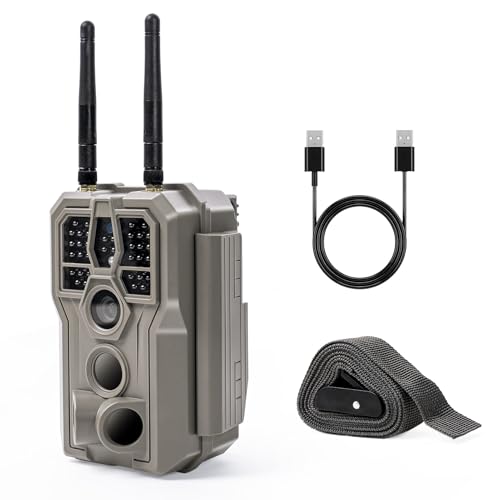
Best choice for those needing strong image quality with on-site management. The E8 2.0 offers 4K video and 64MP photos, powered by WiFi 6 and dual antennas for stable connections up to 165 ft in open areas. It emphasizes on-site viewing through the GardePro Mobile app and does not rely on home WiFi or cellular networks.
Who it’s for: wildlife researchers and homeowners who want high-detail footage and immediate local review, with no remote cloud reliance.
Limitation: signal strength can vary with obstacles like walls or metal structures; not designed for remote web-based viewing.
GardePro E8 2.0 Pro WiFi Bluetooth Trail Camera

Best for high-detail monitoring with robust connectivity. The E8 2.0 Pro features triple-PIR motion sensing, WiFi 6 stability, and dual antennas for dependable performance. It supports 4K video and 64MP stills, with on-site viewing via the app and no need for home networking.
Who it’s for: serious wildlife observers who require reliable long-range coverage and precise motion-triggered captures in remote locations.
Limitation: similar to other non-cellular cameras, it relies on local connectivity and may have limited remote access options.
MAXDONE Solar Trail Camera WiFi Bluetooth

Best for solar-powered, low-maintenance setups. The MAXDONE Solar Trail Camera uses a built-in 6000mAh battery with a detachable solar panel for extended field use. It supports 4K/64MP capture and 65 ft night vision. Important: this version emphasizes solar charging and does not connect to home WiFi, establishing its own local network for setup and file transfer.
Who it’s for: remote sites where frequent battery changes are impractical, and solar charging is feasible.
Limitation: wireless range for setup is limited, and it does not provide remote cloud access or home WiFi integration.
Buying Guide: How to Choose a Long Range WiFi Trail Camera
- Connectivity: Decide between direct phone control (non-cellular) versus cellular or cloud-based viewing. Non-cellular models require proximity for setup and viewing but avoid service costs.
- Range and antenna design: Dual antennas and WiFi 6 support improve stability in open spaces; obstructions like walls and vegetation still affect range.
- Power: Consider battery capacity and whether solar charging is available. Larger batteries extend field life; solar panels reduce maintenance but require sun exposure.
- Image and video quality: Look for 64MP photo resolution and 4K video where detail matters. Consider storage requirements for high-quality media.
- On-site app support: A convenient companion app improves setup, live view, and file transfer directly from the camera.
- Durability and weather resistance: IP ratings and rugged enclosures help in harsh outdoor environments.
- Size and mounting options: Ensure the camera fits your space and can be securely mounted on trees, posts, or stands.
FAQ
- Do these cameras require home WiFi to operate? Some models connect directly to a phone via Bluetooth and built-in WiFi, not to home networks. Check the product notes for each model.
- What is a typical range for reliable wireless transmission? Many models advertise up to 165 ft in open space; actual range drops with walls, metal, or dense foliage.
- Can I view footage remotely without a subscription? Several listed models use on-site apps with no recurring fees; some offer cloud options with plans.
- Is 4K video necessary for wildlife monitoring? It’s beneficial for detail but requires larger storage and faster processing. For basic monitoring, 1080p can suffice.
- What’s the advantage of solar-powered cameras? They reduce maintenance and battery swaps but depend on sun exposure and may still rely on local connectivity.
- Are triple-PIR sensors better for motion detection? They can improve coverage and reduce false triggers, especially in busy outdoor areas.