Video creators using Micro Four Thirds (MFT) want lenses that deliver cinematic look, reliable build, and practical performance. The following five lenses are well-suited for MFT video workflows, from anamorphic aesthetic to compact wide angles. Each option suits different shooting goals from low-light cinema to wide landscapes, giving you clear choices based on your subject, lighting, and budget.
Summary Table of Selected Products
| Product | Best For | Key Benefit |
|---|---|---|
| SIRUI 35mm F1.8 1.33X Anamorphic Lens | Cinematic work, landscapes, interviews | Widescreen 2.4:1 look with 1.33x squeeze |
| SIRUI Night Walker 16mm S35 Wide | Low-light wide scenes | Ultra-fast T1.2 aperture |
| Meike 12mm T2.2 Wide Prime | Landscape and architecture | Low distortion, broad 92° view |
| SIRUI Night Walker 35mm S35 | Portraits and documentaries | Low-light and sharpness with minimal breathing |
| 7artisans MF10mm F3.5 | Travel and street, wide-angle | Compact, budget-friendly, smooth depth |
SIRUI 35mm F1.8 1.33X Anamorphic Lens for MFT

The SIRUI 35mm F1.8 1.33X anamorphic lens provides a cinematic 2.4:1 look by widening the horizontal field of view through its 1.33x squeeze. This lens is built with an aircraft aluminum housing and precise copper focus components, offering a solid yet light design suitable for handheld or gimbal work. Best for creators pursuing a classic anamorphic aesthetic in interviews, music videos, or narrative scenes. A potential limitation is the manual focus and fixed aperture range from F/1.8 to F/16, which may require planning light and focus pulls in dynamic environments.
SIRUI Night Walker 16mm S35 Wide Cine Lens

This 16mm S35 wide-angle cine lens is designed for low-light performance with a bright T1.2 maximum aperture, making it ideal for landscapes, interiors, and documentary scenes where lighting is limited. The wide angle supports expansive compositions, while the close focus distance (as noted in features) enables subtle macro touches within scenes. Best for filmmakers who want deep depth of field control and sharpness in tight spaces. A caveat is that this is a manual focus lens, which may slow production in fast-paced shoots.
Meike 12mm T2.2 Wide Angle For MFT

The Meike 12mm T2.2 is a compact wide prime with a 92° field of view and low distortion, making it a strong choice for landscapes and architectural footage on Micro Four Thirds cameras. The relatively fast T2.2 aperture helps achieve shallow depth of field in brighter conditions, while maintaining sharp images across the frame. Best for shooters who want a lightweight, affordable lens that covers wide scenes. Limitation to note: being a fixed prime, you won’t have zoom flexibility on the fly.
SIRUI Night Walker 35mm S35 Manual Focus Cine Lens

With a large T1.2 aperture and S35 coverage, the Night Walker 35mm is suited for low-light documentary work and portrait scenes. It provides sharpness and minimal focus breathing at wide apertures, enhancing subject isolation. Best for creators who shoot in dim environments or rely on atmospheric lighting. A limitation is the manual focus design, which requires careful focus pulls in moving scenes.
7artisans MF10mm F3.5 Wide-Angle for MFT
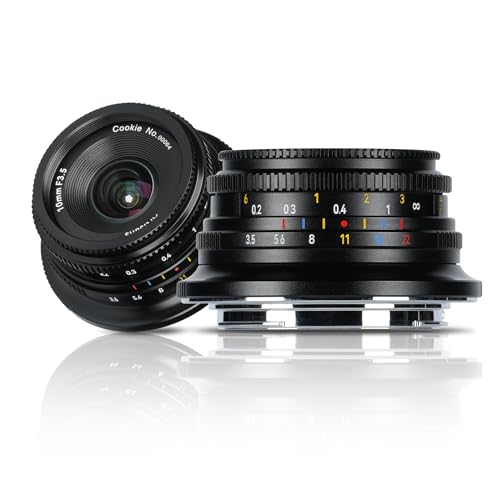
The 7artisans MF10mm F3.5 is a compact, budget-friendly wide-angle prime that avoids typical fisheye distortion. Its 10mm focal length is ideal for travel, street photography, and architectural scenes, offering creative space without heavy gear. Best for vloggers and hobbyists seeking a lightweight option with decent sharpness. It’s manual focus and fixed aperture (F3.5-F16) may require deliberate exposure planning for moving subjects.
Buying Guide
What should you consider when choosing MFT video lenses?
- Sensor coverage: Do you need MFT-compatible S35 or APS-C coverage with a particular look? Anamorphic options like the SIRUI 35mm F1.8 provide a widescreen squeeze for cinematic compositions.
- Aperture and low-light needs: Lenses with T-stop or aperture around T1.2 to F1.8 excel in dim environments; they reduce ISO rise and keep noise down in videos.
- Distortion and perspective: Wide-angle primes reduce distortion and provide natural lines, which is crucial for landscapes and architecture.
- Manual vs. autofocus: Cine lenses in this list are mostly manual. Decide if you need quick focus pulls or precise manual control in the shot.
- Weight and handling: For handheld or gimbal work, lighter builds with robust housings facilitate easier operation during long shoots.
Frequently Asked Questions
- Can I use these lenses on any MFT camera?
Answer: They are designed for Micro Four Thirds systems; compatibility may vary by mount and body. Check camera mount support before purchasing. - Which lens is best for cinematic look?
Answer: The SIRUI 35mm F1.8 1.33X Anamorphic lens offers a classic anamorphic widescreen look suitable for cinematic projects. - Are these lenses all manual focus?
Answer: Most cine lenses in this list are manual focus, designed for precise control in controlled lighting or studio setups. - Which lens is best for low-light indoor scenes?
Answer: The SIRUI Night Walker 16mm S35 and Night Walker 35mm S35 provide large apertures that favor low-light shooting with higher image quality. - Is a wide-angle lens better for landscapes or interiors?
Answer: Wide-angle lenses like Meike 12mm and 10mm lenses are ideal for landscapes and architecture due to their expansive fields of view. - Do these lenses affect cropping or field of view on the camera?
Answer: Some lenses use a crop or S35 format; confirm the coverage (MFT vs S35) to ensure the intended framing and look.