Finding the right microscope lens for camera use improves photo clarity, measurement accuracy, and inspection reliability across electronics, science kits, and Raspberry Pi projects. This guide highlights five versatile options that pair well with cameras via C-mount, HDMI, USB, or WiFi connections. Whether you repair circuit boards, capture micro-details, or document samples for education, these lenses and handheld microscopes offer sharp magnification, solid lighting, and dependable builds. Below, you’ll find quick product snapshots in a summary table, followed by detailed sections with figures, features, and practical notes. Use the Buying Guide to weigh factors like compatibility, illumination, and mounting options before you buy.
| Product | Brand | Key Feature | Magnification |
|---|---|---|---|
| NICE-POWER Digital Microscope Camera | NICE-POWER | HD 1080P HDMI/VGA, 150X C-Mount | 1–150X |
| SKYBASIC Wireless Digital Microscope | SKYBASIC | WiFi streaming, 8 LED lights | 50X–1000X |
| IWOBAC Digital Microscope | IWOBAC | 2MP, smartphone 1080P video | 50X–1000X |
| 8X to 100X C Mount Lens | EBTOOLS | C Mount lens with adjustable magnification | 8X–100X |
| 100X Microscope Lens For Raspberry Pi | waveshare | C/CS-Mount, Pi HQ Camera compatible | 0.12X–1.8X |
NICE-POWER 13MP Digital Microscope Camera

The NICE-POWER digital microscope camera uses a 13MP sensor and outputs 1080P video via HDMI and VGA. It uses a 150X Zoom C-Mount lens with a working distance up to 1000 mm, enabling both close-up and mid-range observation. Magnification ranges from 1X to 150X, adjustable via the lens dial, making it suitable for electronics repair, coin inspection, and component analysis. A bright LED ring light with 56 LEDs at 6500K-7000K provides consistent illumination and up to 60,000 lux, helping reveal fine details on solder joints and textures. The foldable stand enhances stability during longer imaging sessions, supporting precise alignment and reduced shake. This setup pairs well with project boards, electronics work, and small-scale inspection tasks.
- HDMI/VGA output for direct monitor viewing
- 150X zoom with up to 1000 mm working distance
- 56-LED ring light; 6500K-7000K color temperature
- Foldable stand for stable imaging
- 13MP sensor for clear, detailed captures
SKYBASIC Wireless Digital Microscope

The SKYBASIC wireless digital microscope focuses on mobility and quick sharing. It creates its own WiFi hotspot to stream 1080P video to smartphones or tablets and also supports USB connectivity to Windows or Mac computers when a wired link is preferred. Eight adjustable LEDs provide bright, even illumination, boosting detail on dark or reflective surfaces. A 2MP CMOS sensor delivers 1920×1080 video for mobile viewing, with magnification in the 50X–1000X range. A compact, handheld design makes this device ideal for fieldwork, classrooms, or quick inspection tasks where portability and wireless sharing are beneficial. The device emphasizes ease of use and rapid setup for diverse applications.
- WiFi hotspot for mobile viewing; USB for computer use
- Eight adjustable LEDs; bright, even illumination
- 2MP CMOS sensor; 1080P video on mobile
- Magnification: 50X–1000X
- One-button photo/video capture via accompanying app
IWOBAC Digital Microscope
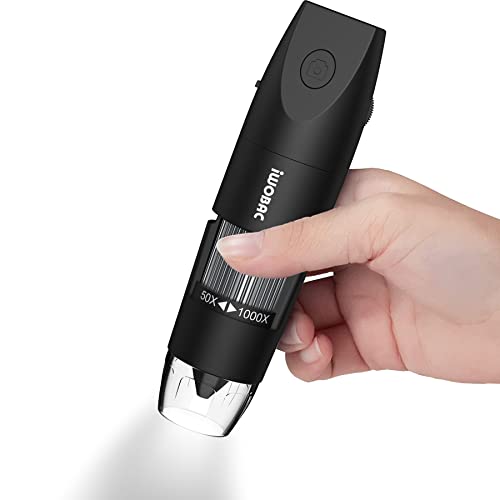
The IWOBAC digital microscope emphasizes portability with practical connectivity options. It offers a fixed-focus design and a 2MP sensor that supports 1080P output to smartphones and tablets, with 720P available for computer viewing. Eight dimmable LEDs enable flexible lighting for varied subjects, from textiles to coins to electronics. The device supports both WiFi and USB connections, plus an accompanying app for easy control and image capture. Compatibility spans Android 6.0+, iOS 9.0+, Windows, and Mac, making it a versatile choice for education, hobbyists, and technicians who need quick, shareable macro views on multiple platforms.
- 2MP sensor; 1080P mobile output; 720P for computer
- Eight dimmable LEDs for adjustable lighting
- WiFi and USB connectivity; dedicated app
- Android, iOS, Windows, Mac compatibility
- Fixed-focus design; portable and easy to use
8X to 100X C Mount Lens

The EBTOOLS 8X to 100X C Mount Lens provides a practical accessory for industrial microscope cameras. Built for durability, it offers adjustable magnification across a useful range for quick inspections of electronics, circuits, and small components. The C Mount interface ensures compatibility with many consumer and lab cameras, and installation is straightforward for upgrading image detail without purchasing a new system. This makes it a flexible option for technicians who already own a microscope body or camera with a C Mount and want enhanced magnification control.
- C Mount compatibility; easy installation
- Magnification adjustable from 8X to 100X
- Durable build for repeated use
- Designed for industrial microscope cameras
100X Microscope Lens For Raspberry Pi

The Waveshare 100X Microscope Lens for Raspberry Pi targets Pi enthusiasts seeking compact, mountable optics. It uses C/CS-Mount interfaces and supports a magnification range from 0.12X to 1.8X, enabling close-up imaging with the Raspberry Pi HQ Camera. The lens kit is designed for quick mounting with minimal setup and straightforward software integration, making it a practical add-on for Pi-based micro-labs, education, and prototype development. While not a full microscope, this option extends Pi projects with higher-detail capture and flexible field-of-view options for small-scale experiments.
- C/CS-Mount compatibility; Pi HQ Camera ready
- Magnification range: 0.12X–1.8X
- Compact, easy to mount; simple software integration
- Ideal for education, prototyping, and DIY micro-projects
Buying Guide
When choosing a microscope lens for camera use, consider what matters most for your workflow, environment, and budget. The following factors help compare options across the five featured products and similar devices.
- Match Your Use Case: Fieldwork, lab benches, and classrooms each benefit from different strengths. For electronics repair, prioritize devices with stable stands, bright illumination, and reliable HDMI/USB capture. Raspberry Pi projects benefit from Pi-friendly mounts and software compatibility. For education or casual use, portability, ease of use, and sharing capabilities matter most.
- Mounting And Compatibility: Decide between C-Mount/CS-Mount lenses for fixed cameras or integrated devices with HDMI/USB/WiFi. If reusing an existing camera, ensure the lens thread matches (C or CS) and verify working distance to avoid sample crowding. Consider adapters and mounting flexibility for future upgrades.
- Magnification Range And Working Distance: A wider magnification range offers flexibility, but higher zoom can limit light and depth. Long working distances help with larger components, while shorter distances provide stronger close-ups. Assess whether you need versatile zoom or precise fixed magnifications for your samples.
- Illumination And Color Fidelity: LED lighting is essential for macro imaging. Check brightness (lux) and color temperature (Kelvin) to ensure natural color rendering and minimal glare on reflective surfaces. Some devices offer adjustable brightness or diffusers to tailor lighting for different materials.
- Sensor Resolution And Output: For mobile sharing, 1080P or higher is desirable. A 2MP or higher sensor typically yields crisper detail, especially at higher magnifications. Verify compatibility with your display or capture workflow (HDMI, USB, or WiFi streaming).
- Connectivity And Software: USB-connected cameras may require drivers, while HDMI devices stream directly to displays. WiFi options enable quick sharing and remote viewing but may rely on app stability. Check available software for image capture, annotation, and export formats on your platform (Windows, macOS, Android, iOS, or Raspberry Pi).
- Portability And Stability: Handheld, WiFi-enabled devices are convenient for on-the-go work, while fixed stands and foldable legs improve stability during precise measurements. Consider whether you need a compact, travel-friendly option or a larger setup for extended sessions.
- Maintenance And Durability: Opt for sturdy builds, reliable lens coatings, and easy-to-clean optics. Keep cleaning tissues and microfiber cloths handy, and follow manufacturer guidance to protect coatings and prevent scratches.
- Budget And Value: Balance feature sets with price. A higher upfront cost may deliver better durability, optics, and software, while a basic model can suffice for simple tasks. Look for warranties, spare parts availability, and reputable support when evaluating options.
- Scenario-Specific Guidance: For electronics repair, prioritize high-quality LED lighting, robust HDMI/USB capture, and sufficient working distance. For Raspberry Pi projects, favor lenses with Pi-friendly mounting and straightforward software integration. For education, emphasize ease of use, portability, and clear documentation to support learners.