If you’re looking to digitize decades of photos, negatives, and slides, a dedicated photo and film scanner offers a straightforward, table-safe path to high-quality digital files. These scanners are designed for hands-off operation, built-in screens for quick previews, and wide compatibility with 35mm, 110, and other common film formats. This guide highlights five reliable options, explaining who each is best for and why it stands out.
| Product | Best For | Key Advantage |
|---|---|---|
| DigitPro Photo Scanner and Film Digitizer (5” Screen) | Home users with mixed media collections | All-in-one unit with no computer needed |
| KODAK Slide N SCAN Film & Slide Scanner (5” LCD) | Traditional film enthusiasts | Direct SD save, multiple film formats |
| Plustek ePhoto Z300 | Desktop photo archiving | Fast 4×6 scans, supports various photo sizes |
| ClearClick QuickConvert 2.0 | Simple, quick digitization | No computer required, compact and portable |
| Epson FastFoto FF-680W | High-volume photo digitization | High speed with batch scanning |
Buyer’s note: The best choice depends on your media mix (photos vs. negatives/slides), the preferred workflow (standalone vs. computer-assisted), and how many images you need to digitize. The following sections break down each option’s strengths, with practical guidance for selecting the right scanner for your needs.
DigitPro Photo Scanner And Film Digitizer
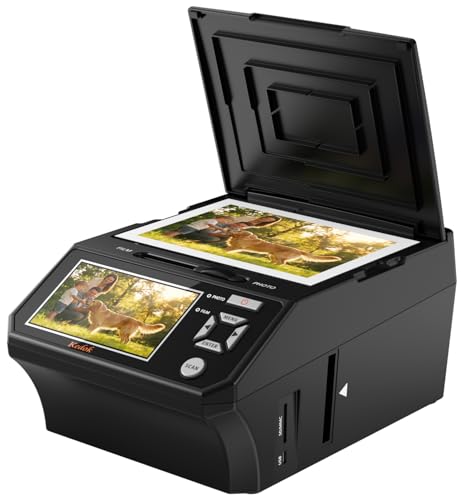
Best for households with mixed media. This all-in-one device handles 35mm slides, 135 & 110 negatives, printed photos (3R, 4R, 5R), and business cards. It includes an 8GB SD card and does not require a computer, making it ideal for instant digitization without software setup. The built-in 5-inch LCD provides immediate color preview, reducing the guesswork when scanning. One-touch operation keeps the process simple—great for grandparents and busy family historians.
Limitation: Standalone operation may limit advanced editing; plan to transfer to a computer if you want substantial post-processing.
Who it’s best for: Families preserving a broad legacy across film and print formats, who prefer a single, self-contained scanner.
KODAK Slide N SCAN Film & Slide Scanner

Best for traditional film enthusiasts who want a dedicated screen and SD card workflow. The 5” LCD provides a clear preview, and the device supports 135, 110, and 126 formats with included adapters. Its continuous-load design (quick-feeding tray) speeds up digitizing multiple frames and the kit includes a slide holder and cleaning tools. It saves directly to SD cards, which keeps your workflow simple and portable.
Caution: SD card not included in some bundles; you’ll need compatible storage to complete the transfer.
Who it’s best for: Users who frequently digitize multiple slides or negatives and value an integrated viewing screen with straightforward saving to memory cards.
Plustek ePhoto Z300

Best for desktop photo archiving and quick batch processing. The ePhoto Z300 scans 4×6 photos in about 2 seconds and supports common print sizes (3×5, 4×6, 5×7, 8×10) plus paper formats. It uses a CCD sensor for reliable color capture and offers dual-speed options (300 dpi and 600 dpi). It’s positioned as more efficient than traditional flatbeds because you insert photos one by one, streamlining the workflow for large photo collections.
Limitation: Primarily designed for photos; it doesn’t target film negatives or slides, so you’ll need a separate device for those formats.
Who it’s best for: People with large photo albums who want a fast, dedicated photo scanner for single-page documents and photos.
ClearClick QuickConvert 2.0
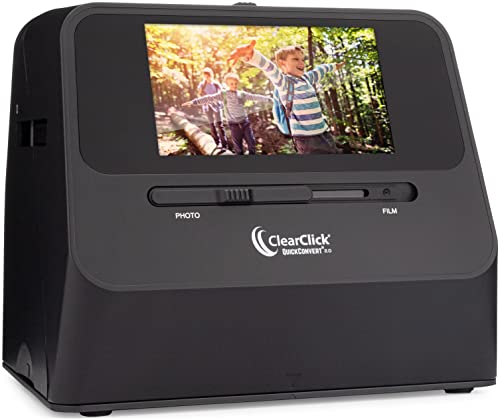
Best for simple, no-fuss digitization with light on-the-go needs. This scanner handles photos up to 4×6 and 35mm/110/126 film in one device without a computer. It scans at 14MP, with interpolation to 22MP, and saves JPEGs to an SD card. A built-in 5″ LCD provides instant previews, and a rechargeable battery enables cord-free operation for quick sessions. It’s a compact solution for quick archiving and sharing.
Caution: No automatic feeder; scanning is one-by-one, which may take longer for large batches.
Who it’s best for: Casual users who want a compact, battery-powered option for occasional digitization of photos, slides, and negatives.
Epson FastFoto FF-680W

Best for high-volume photo archiving. The FastFoto system is designed to scan thousands of photos quickly, with claims of up to one photo per second at 300 dpi and batch scanning support for up to 36 photos. It focuses on transforming old pictures into digital files efficiently and includes the Epson FastFoto mobile app features for creating slideshows and adding contextual data. It’s well-suited for serious archival projects.
Limitation: It emphasizes speed and capacity; more complex editing or restoration tasks may require additional software or workflow steps.
Who it’s best for: Individuals or families with large collections of printed photos who need rapid, scalable digitization and organization support.
Buying Guide
- Media types supported: If you own a mix of prints, 35mm negatives, and slides, choose an all-in-one model to minimize switching devices. If you primarily digitize prints, a fast photo-only scanner may be ideal.
- Workflow preference: Standalone units are great for quick digitization without a computer, while PC-connected options offer more editing flexibility with software.
- Screen size and preview quality: A larger LCD helps verify scans before saving, reducing wasted effort on poor captures.
- Storage and file handling: Look for SD card support or external storage compatibility; ensure the device saves native image formats you can edit later (JPEG/TIFF options matter).
- Speed versus accuracy: CCD-based scanners generally deliver consistent color, while high-speed batch scanners excel with large collections. Balance speed with desired color fidelity.
- Future-proofing: Cards and drives can become obsolete; ensure the scanner allows easy transfer to modern systems and supports common file formats.
FAQ
- Do I need a computer to use these scanners? Some models operate standalone with built-in screens and memory; others require a computer for saving and editing scans.
- What formats do these scanners save? Common formats include JPEG; some models offer TIFF or RAW-like outputs depending on the device and memory options.
- Can I scan both photos and negatives with the same device? Yes, but for best results you may prefer a model designed to handle both media types in one pass.
- Is high resolution necessary for archival quality? Higher resolutions capture more detail; consider at least 3000+ x 2000+ pixel outputs for large prints, but balance with file size and storage.
- How do I preserve color accuracy? Look for devices with built-in color correction tools and support for calibration or soft proofing if you plan extensive editing.
- What should I consider about memory cards? Ensure compatibility with FAT32/ExFAT formats and card capacities that fit your scanning volume.