Whether you’re preserving family history or archiving a slide collection, a dedicated photo and negative scanner makes it fast and easy to convert prints, negatives, and slides into high-quality digital files. This guide highlights five reliable options that balance ease of use, screen size, and standalone operation. Best suited for: families digitizing old photos, hobbyists preserving vintage slides, and small home archives seeking a simple, all-in-one device. The comparison below helps you choose based on screen size, memory, and whether a computer is needed for operation.
| Product | Best For | Key Benefit |
|---|---|---|
| KODAK Slide N SCAN | Casual collectors with 135/110/126 slides | 5” LCD, quick-load trays |
| DigitPro Photo Scanner | All-in-one convenience, no PC | 5” screen, 22MP output |
| Kedok Slide & Negative Scanner | Gift-worthy, family memories | 4-in-1 functionality, 22MP |
| ClearClick QuickConvert 2.0 | Simple, fast standalone scanning | 2-3 seconds per item, 22MP interpolated |
| Magnasonic All-in-One 24MP | High-resolution film and slide capture | HDMI output, built-in memory |
KODAK Slide N SCAN Film & Slide Scanner

Best for: casual collectors who want a 5” LCD viewfinder and straightforward loading for 135, 110, and 126 film and slides. This scanner outputs to SD and offers a gallery-friendly display for quick previews. It includes a 50mm slide holder and adapters to cover common film formats, plus USB and HDMI connections for easy sharing and display. A potential limitation is the need for an SD card (not included) to save files.
DigitPro Photo Scanner and Film Digitizer
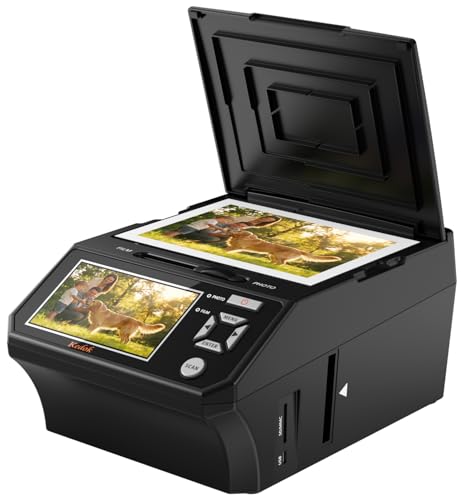
Best for: users who want an all-in-one device that can convert 35mm/110 negatives, slides, and printed photos without a computer. The 5” LCD makes reviewing easy, and the device ships with an 8GB SD card for immediate storage. It’s a simple, stand-alone solution, ideal for parents and grandparents digitizing a mix of media. Limitation: no computer needed, but you may outgrow it if you need larger storage or more advanced editing later.
KEDOK Photo, Name Card, Slide & Negative Scanner

Best for: families seeking a versatile 4-in-1 scanner that handles 35mm/110 negatives, slides, and name cards. The 5” LCD provides instant previews, and the internal memory plus 8GB SD card ensure quick saving directly to the unit. It is a thoughtful gift option for holidays. Caution: image quality and color accuracy depend on the source material, and users may want to calibrate expectations with older media.
ClearClick QuickConvert 2.0
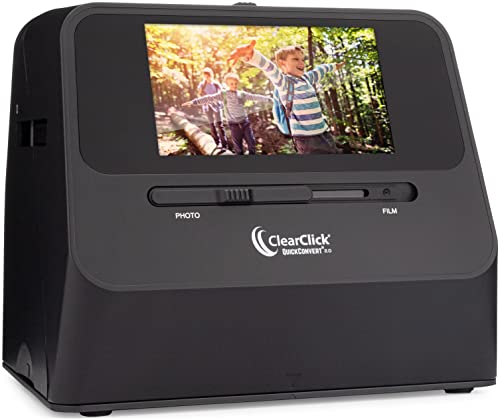
Best for: those who want fast, one-at-a-time scanning of photos, slides, and negatives with no computer. It scans 4×6 photos or smaller quickly and saves as JPEG with a built-in 5″ LCD preview. Limitation: it lacks an auto-feeder and is best for smaller batches or occasional use rather than high-volume archiving.
Magnasonic All-in-One 24MP Film Scanner

Best for: enthusiasts who want high-resolution 24MP scans of 35mm, 110, 126, and Super 8 with HDMI output for TV viewing and built-in memory for standalone use. The 5” display helps with immediate review, and HDMI connectivity supports broader display options. Caution: HDMI cable is not included, and file management may require extra steps for large archives.
Epson FastFoto FF-680W

Best for: high-volume photo collectors who need rapid batch scanning and the ability to organize with the Epson app. The FastFoto excels at speed (up to one photo per second at 300 dpi) and batch processing of multiple photos. It’s a strong fit for preserving large collections quickly, though it focuses more on photos than film or slides, and it may require additional adapters for certain media types.
Plustek Photo Scanner ePhoto Z300

Best for: users who want fast photo scanning with auto crop and deskew while supporting common photo sizes. It’s positioned as a more efficient option than a flatbed scanner for photo-heavy archives. Limitation: it emphasizes photos over film, so if you need extensive film support, pairing with another device might be beneficial.
Buying Guide: Key Considerations For Choosing A Photo And Negative Scanner
- Media compatibility: Match the device to your media mix (prints, 35mm/135, 110, 126 negatives, slides, and name cards). Some scanners handle a wider range while others focus on photos.
- Display size and preview: A larger LCD helps with quick visual checks. A built-in screen reduces the need for a connected computer during the scanning flow.
- Standalone vs. computer-required: Decide if you prefer plug-and-play operation or need advanced editing software integration later. Standalone models save time for large batches.
- Storage options: Check internal memory and SD card support. Large archives benefit from higher-capacity cards or external backups.
- Output quality: Resolution (MP or interpolated MP) and color accuracy matter for long-term preservation. Consider whether you’ll reprint or display images on large screens.
- Ease of use and workflow: Look for one-button scanning, continuous loading, or batch features if you have many items. Avoid devices with complex driver requirements if you value speed.
- Portability and design: For home use, a compact, easily accessible device can streamline your archive project. For office or classroom use, consider reliability and ease of maintenance.
Frequently Asked Questions
- What media can a typical photo scanner convert? A: Most scanners support 35mm/135, 110, and 126 negatives, slides, and printed photos of common sizes (3R, 4R, 5R). Some models also handle name cards and Super 8 film.
- Do I need a computer to use these scanners? A: Some units are standalone with internal memory and SD card storage; others can require a computer for software-based editing or saving files.
- What resolution should I expect from these devices? A: Many scanners deliver 22MP or higher output, with some offering interpolated enhancements. Actual results depend on source material and sensor quality.
- Is an SD card included with these scanners? A: Several models come with SD cards (often 4GB–8GB), while others require you to provide your own memory for saving files.
- Can these scanners help with large photo collections quickly? A: Yes, high-volume options (like the Epson FastFoto) offer batch scanning and fast speeds to accelerate archiving projects, though they may prioritize photos over film.
- Are HDMI outputs useful for scanning devices? A: HDMI can enable viewing on a larger display, which is helpful for reviewing slides and negatives before saving or sharing.