When digitizing old photos, you want a scanner that delivers clear images fast and with minimal effort. This guide highlights five top options and explains who each is best for. Whether you’re archiving a family album, preserving travel prints, or converting negatives, these picks balance simplicity, speed, and image quality for American buyers. Below is a quick summary to help you choose at a glance.
| Product | Best For | Notes |
|---|---|---|
| Plustek ePhoto Z300 | Casual photo digitizing, 3×5–8×10 prints | Fast 2s per 4×6; easy feed |
| Epson Perfection V19 II | Photos and documents with high detail | Compact flatbed, good color |
| Epson FastFoto FF-680W | Large batches of memories | High-speed, wireless, up to 8×10 |
| Canon CanoScan LiDE 400 | Wide compatibility, compact desk setup | Fast 8-second scans, USB-C |
| DigitPro Photo Scanner | All-in-one for slides, negatives, prints | Standalone, 5″ screen |
Plustek Photo Scanner ePhoto Z300

The Plustek ePhoto Z300 is designed for quick digitization of common photo sizes (3×5, 4×6, 5×7, 8×10) with a CCD sensor. It delivers up to 600 dpi optical resolution and boasts a fast 2-second scan time for a 4×6 photo. It’s positioned for casual users who want a straightforward, desk-friendly solution that’s more efficient than a traditional flatbed scanner. Best for households cataloging family albums or small projects where speed matters. A potential limitation is its resolution cap compared to high-end flatbeds, which may matter for large enlargements.
Best for: families digitizing printed photos quickly; choose this if you want a fast, simple setup without complex software.
Epson Perfection V19 II Color Photo and Document Flatbed Scanner

The Epson Perfection V19 II offers a high 4800 dpi optical resolution for sharp photos and detailed enlargements. It includes Epson ScanSmart software and one-step scanning with user-friendly buttons. This flatbed is best for preserving a mix of photos and documents where you may need to scan delicate prints or oversized items that won’t fit a feed-through scanner. Limitation: slower batch processing compared to dedicated high-speed photo scanners.
Best for: users who need versatility between photos and documents; better for occasional batch work and preserved prints with solid color accuracy.
Epson FastFoto FF-680W

The Epson FastFoto FF-680W is designed for high-volume photo scanning. It can scan hundreds to thousands of photos rapidly (up to about 1 photo per second at 300 dpi) and supports batch scanning of up to 36 photos. It’s well-suited for families or small offices digitizing large print collections. It also offers mobile sharing capabilities via the Epson FastFoto app. A caveat is its larger size and higher upfront cost, which may not suit tight spaces or tighter budgets.
Best for: large photo archives or families with many prints; choose this if you need speed and batch capabilities, and you don’t mind a bigger device.
Canon CanoScan LiDE 400

The Canon CanoScan LiDE 400 combines speed and simplicity with 4800 x 4800 dpi resolution, helping preserve fine photo detail. It includes auto-scan mode and dust removal enhancements, making it easier to capture clean images from a desk setup. The USB-C connection enables a tidy power and data setup. It’s best for users who want a compact, reliable flatbed for occasional photo restoration and quick captures. Limitation: not designed for heavy batch scanning or negatives without adapters.
Best for: desk setups needing reliable color accuracy; avoid this if you require constant high-volume batch scanning or negative scanning in one machine.
Canon Canoscan Lide 300

The Canon Canoscan LiDE 300 offers compact design with auto scan mode for easy use. It’s built around a simple USB connection and is suitable for light, everyday photo scanning and document tasks. It’s best for beginners or those who want a budget-friendly option that covers essential scanning needs. Limitation: fewer advanced features and slower manual controls compared to higher-end models.
DigitPro Photo Scanner And Film Digitizer
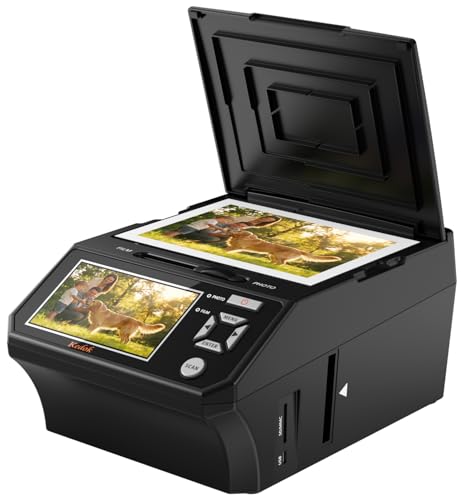
The DigitPro unit is an all-in-one standalone scanner with a 5″ large screen and built-in memory card support. It scans 35mm slides, negatives, and printed photos up to 22MP digital quality, without needing a computer. Best for users who want a simple, self-contained device for quick digitization on the sofa or desk. Limitation: may offer fewer advanced editing options compared to computer-connected scanners.
Buying Guide
- What will you primarily scan? If you have lots of prints, a fast throughput model like a dedicated photo scanner or a high-speed flatbed works best. If you also need to scan negatives or slides, look for a unit with included film handling.
- Resolution matters. For large enlargements and archival quality, aim for 4800 dpi or higher. If you mainly share digital photos online, 600 dpi to 1200 dpi can be sufficient.
- Feed vs. flatbed. A feed-through (automatic document feeder or photo tray) is faster for bulk work but may be less flexible for delicate or thick items. A flatbed provides versatility for albums and odd sizes.
- Connectivity. USB-C is common in newer models and can simplify power and data connections. Wireless scanning is convenient but may depend on app support.
- Software and workflow. Look for built-in or bundled software that supports easy cropping, color restoration, and file organization. Some models offer direct cloud or app integration for sharing.
FAQ
- What resolution is enough to preserve memories? For most photos, 300–600 dpi is sufficient for archival quality; 1200 dpi is good for large prints.
- Can I scan negatives with all-in-one scanners? Some models handle slides and negatives; others are print-only. Check product specs for film scanning support.
- Is a standalone scanner better than using a computer? Standalone units are easier for quick digitization without software; computer-connected scanners offer broader editing options.
- Do I need special software? Many scanners include companion software for color correction and file organization. Third-party editors can also be used.
- How should I care for old photos before scanning? Handle gently, remove dust with a soft brush, and store originals in protective sleeves to minimize damage during scanning.
- Are high-end scanners worth the investment? If you have a large collection or require supreme detail, higher-end options can justify the cost; for casual archives, mid-range models are often sufficient.