If you want to bring your vintage slides, negatives, and photos into the digital age, the right slide and negative digitizer can save time and preserve memories. This guide focuses on compact, user-friendly standalone scanners that don’t require a computer to operate. Ideal buyers include beginners who want simple one-step scans, families digitizing aging photo collections, educators organizing historical materials, and seniors who prefer straightforward devices with built-in screens.
Below you’ll find five top options that balance ease of use, screen size, and scan quality. For quick comparison, a brief summary table highlights each model’s strengths and intended user. All descriptions reference listed features to explain why each item is a good pick for specific needs.
| Product | Best For | Key Benefit |
|---|---|---|
| KODAK Slide N SCAN | Casual family use | 5” LCD, quick-feed tray |
| HP Touch Screen Film Scanner | Beginners and hobbyists | 13 MP sensor, touch preview |
| KODAK Slide N Scan Max | Digital picture framing | Tiltable 7” LCD |
| DigitPro Photo Scanner | All-in-one with SD card | 22 MP, built-in memory |
| DigitConvert 35mm & 135 | Portable, simple setup | 2.4” LCD, plug & play |
KODAK Slide N SCAN Film & Slide Scanner

This model supports 135, 110, and 126 film formats and slides, with a 5” LCD display that doubles as a gallery frame. It uses a 1422 MP equivalent workflow to preview, edit, and save to an SD card (SD card not included). The convenient easy-load film insert trays enable rapid scanning, and a 50mm slide holder plus adapters simplify digitizing multiple formats at once. Best for families who want a straightforward, built-in screen experience without a computer. Limitation: SD card required for storage and sharing, not included in the package.
KODAK Slide N Scan Max Digital Film Scanner

The Max version features a 7-inch tiltable LCD with gallery mode for immediate review, plus a 13 MP sensor for better image capture. Its quick-feed tray supports continuous scanning, making it well suited for projects with many slides or negatives. Best for users who want a larger, adjustable viewing area and the ability to preview results instantly. Caution: tilting and gallery functionality may require familiarization for first-time users.
Photo Scanner And Film Digitizer With 5” Screen
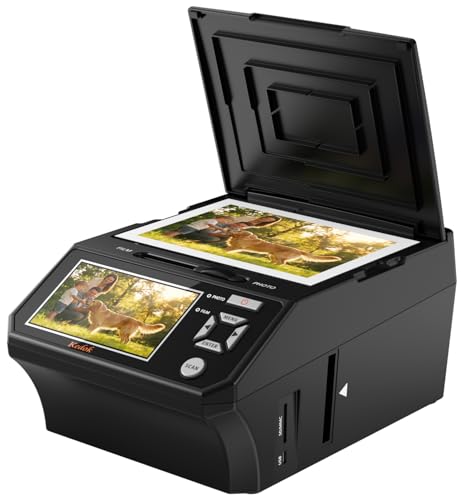
This all-in-one device handles 35mm and 110 negatives, slides, and even printed photos, with an 8 GB SD card included for immediate storage. The 5” LCD allows eye-level preview and easy edits without a computer. Best for households seeking a versatile, stand-alone scanner with built-in memory and broad media support. Limitation: memory is modest by design and may require additional SD cards for large collections.
KEDOK Photo,NameCard,Slide & Negative Scanner

KEDOK combines 22 MP digital film scanning with support for 135 and 110 negatives, slides, name cards, and photos. It includes an 8 GB SD card and offers a large 5” screen for instant review. Best for gift-worthy devices that cover multiple media types in a single, stylish package. Limitation: some users may prefer models with more extensive internal memory or larger expansion options for big archives.
DigitConvert 35mm Film And Slide Scanner

DigitConvert offers a compact 2.4″ LCD preview and editing screen with stand-alone operation. It supports 35mm film and 135 film scanning with batch capabilities and saves to SD cards up to 128 GB (card not included). Best for seniors or minimalists who want a tiny, portable unit with simple one-step scanning. Caution: smaller screen may be challenging for detailed color correction or precise edits.
Buying Guide
What should you consider when choosing a slide and negative digitizer?
- Screen size and usability: Larger screens ease previewing and editing. If you’ll share on a gallery display, look for gallery modes or tiltable screens.
- Media compatibility: Confirm support for 35mm, 110, 126, slides, and even printed photos or name cards if needed.
- Storage options: Built-in memory or included SD cards simplify setup. Consider expandable storage for large archives.
- One-step vs. computer-based: Stand-alone devices are faster for simple digitization, while computer-connected scanners may offer advanced editing options.
- Connectivity: HDMI or USB outputs enable easy transfer to TVs or computers. Check for compatibility with your preferred workflow.
- Ease of use: Quick-feed trays and auto-loading features reduce hands-on time, especially for large libraries.
Why choose a stand-alone digitizer?
Standalone digitizers eliminate the need to install software, connect to a computer, or learn complex workflows. They’re ideal for non-technical users, older generations, and casual hobbyists who want quick results and simple sharing. Choose this option if you value a built-in screen for instant previews and a straightforward, time-efficient process.
Media type strategy
For families with mixed archives (slides, negatives, printed photos, and even name cards), a multi-format scanner provides value by handling several media types in one device. If your collection is mostly 35mm slides and negatives, prioritize models with reliable 13 MP or higher sensors and an adequate feed tray for fast batch scanning.
Storage and future-proofing
Look for devices that support SD cards up to 32 GB or more and offer compatibility with standard formats like JPEG. If you expect to digitize thousands of images, consider devices that support larger cards or optional external storage to avoid frequent card swaps.
FAQ
- What is the main advantage of a 5″ LCD viewer?
You gain on-device preview and editing without a laptop, which speeds up the process. - Do these scanners require a PC for basic scanning?
Most listed models operate standalone or with minimal computer dependence, though some features may be enhanced with a PC. - Can I digitize 35mm, 110, and slides with one device?
Yes, several models in this list support multiple formats, including 35mm and various slide types. - Is an included SD card essential?
An SD card is convenient for immediate storage, but you can also use your own higher-capacity card if supported. - What should I avoid when buying?
Avoid devices with very small screens, limited format support, or slow batch scanning if you have large archives.