Answering the common buyer need: these slide-to-JPEG converters digitize film negatives and slides quickly, letting you save memories as high-quality digital files. This guide focuses on reliable, user-friendly options ideal for preserving family photos, school memories, or vintage film collections. The top picks include models with built-in displays, quick-load feeders, and standalone operation. Best for beginners who want a simple, all-in-one solution; better for avid archivists who value high resolution; choose this if you prefer plug-and-play with minimal setup.
Overview at a glance: the following table summarizes five strong choices for converting slides and film to JPEG, including their standout strengths and who they suit best.
| Product | Best For | Key Benefit | Note |
|---|---|---|---|
| KODAK Slide N SCAN | Families and new collectors | 5” LCD for on-device preview; supports 135/110/126 formats | Includes slide holders and adapters |
| Magnasonic All-in-One 24MP | Archivists with large collections | Built-in memory; 5″ display; HDMI output | Good for direct TV/monitor viewing |
| DigitPro 35mm Film & Slide Scanner | Seniors and beginners | 2.4” LCD, fast slide feeder, standalone operation | No PC required |
| DigitConvert 35mm Film Scanner | Casual collectors | Standalone with adjustable brightness/color; easy loading | Compact and portable |
| KODAK SCANZA Digital Film & Slide Scanner | All-around homes | Supports multiple film types; large 3.5″ LCD; many adapters | Versatile for various formats |
KODAK Slide N SCAN Film & Slide Scanner

Best for: first-time digitizers and households with mixed-format slides (135, 110, 126). This model offers a 5” LCD for immediate previews and editing, and converts 135/110/126 film and slides to high-resolution JPEGs. It uses a quick-load tray for continuous scanning and includes adapters, a cleaning brush, and USB/HDMI outputs. Limitations: SD card storage is not included, so users must supply a card to save scans. The product is well-suited for family archives and casual memory preservation.
Magnasonic All-in-One 24MP Film Scanner

Best for: those who want high resolution capture and flexible viewing. This scanner converts 35mm/110/126/Super 8 film and 135/126/110 slides into 24MP JPEGs. It features a built-in 5″ LCD for direct viewing and an HDMI output for larger displays. It includes 128MB internal memory and supports up to 128GB SD cards, enabling offline storage. Caution: HDMI output requires compatible display and cables not included in the box.
DigitPro 35mm Film & Slide Scanner

Best for: seniors or users who want a straightforward, standalone device. The 2.4″ LCD enables immediate preview and editing, with a fast slide feeder for continuous loading. It supports 135 negatives and slides, providing high-quality JPEG outputs without a computer. Caution: Some users may prefer larger screens for detailed editing, though the device prioritizes simplicity and portability.
DigitConvert 35mm Film Scanner

Best for: casual collectors seeking portability and simplicity. This 2.4″ LCD scanner offers standalone operation with adapters for 35mm negatives and slides. It supports 135 film digitization and includes easy loading for batch scanning. A small caveat: while it is compact, some users may prefer higher MP output for very large prints or precise color work.
KODAK SCANZA Digital Film & Slide Scanner
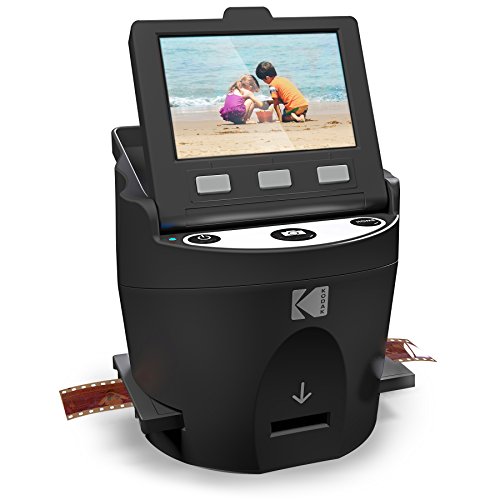
Best for: versatile households needing broad format support. The Scanza converts 35mm, 126, 110, Super 8, and 8mm negatives and slides to JPEG with a 3.5″ LCD and multiple adapters. It emphasizes quick one-touch scanning with large controls, making it a compelling option for multi-format archival projects. Limitation: not all film formats are supported equally across all batch modes, so verify compatibility with your collection.
Buying Guide
How to choose the right slide-to-JPEG converter:
- Output resolution: Look for at least 22–24MP JPEG quality to preserve detail.
- Display and editing: A built-in LCD helps preview and adjust brightness/color before saving.
- Film types supported: Ensure the device handles your formats (35mm, 126, 110, Super 8, etc.).
- Standalone vs. PC-dependent: If you want simple one-device operation, choose standalone units.
- Memory options: Built-in storage or SD card support affects how many scans you can store without uploading.
- Connectivity: HDMI or TV-out can help view scans on larger screens; USB is standard for transfers.
- Load speed: Quick-load feeders reduce handling time for large archives.
- Cost vs. versatility: Multi-format scanners are more versatile but may be pricier than single-format models.
FAQ
- Do these scanners require a computer to save images?
Some models are standalone; others save directly via SD cards or internal memory. - What is the typical maximum film size they support?
Most support 35mm, plus additional formats like 126 or 110; check each model’s adapters. - Can I view scans on a TV or monitor?
HDMI or TV-out features enable larger screen viewing. - Is built-in storage necessary or should I use an SD card?
Built-in storage is convenient, but SD card support expands capacity significantly. - Which is best for a large archive?
A scanner with a fast feeder and high MP output, such as Magnasonic or Scanza, is advantageous for big jobs.