Answering the need for portable, reliable external displays, these compact HD camera monitors provide brighter screens, focus aids, and exposure tools for on-the-go shooting. Ideal for independent videographers, travel filmmakers, and content creators who require accurate monitoring without bulky rigs. This guide highlights five top options, each with a clear use case and practical trade-offs.
| Product | Best For | Why It Stands Out |
|---|---|---|
| NEEWER F700 7″ Field Monitor | DSLRs and mirrorless rigs needing 2000 nit brightness | High brightness, 4K HDMI loop in/out, 3D LUTs, extensive waveform tools |
| FEELWORLD F5 PROX 5.5″ | Outdoor shoots needing compact, bright view | 1600 nit brightness, accurate focus/exposure tools, LUT preview |
| FEELWORLD S55 V3 6″ | Indoor studios and travel rigs | HD 1920×1080 IPS, robust monitoring tools, sun hood included |
| FEELWORLD FW759 7″ (HD 1280×800) | Lightweight field monitoring | Slim, portable, reliable focus/exposure aids, 4K HDMI input |
| NEEWER F100 7″ Field Monitor | Balanced rigs with battery flexibility | Compact 7″ IPS, F750 battery, broad format support |
NEEWER F700 7″ Field Monitor

Key features include a 7-inch IPS touch screen with 1920×1080 resolution and 2000 nit brightness. It supports 4K HDMI loop in/out, multiple video formats, and a range of professional tools such as false color, zebras, histogram, waveform, and HDR. It offers both manual and automatic backlight adjustment, a 180° adjustable bracket, and true 3D LUT support with 15 preloaded LUTs and up to 60 custom LUT uploads. Best for shooters who need a bright, feature-rich monitor in bright outdoor environments or on handheld rigs.
Who it’s best for: documentary shooters and indie filmmakers using DSLRs or mirrorless cameras who require bright visibility, waveform monitoring, and quick LUT access. The included dual NP-F750 battery setup supports longer sessions in outdoor or event settings.
Caution: The unit relies on compatible power options; ensure extra battery or USB power if filming extended outdoor shoots. Some users may prefer a lighter 5.5–7 inch option for extremely compact rigs.
FEELWORLD F5 Prox 5.5 Inch

The FEELWORLD F5 PROX measures 5.5 inches and delivers 1600 nit brightness with built-in focus peaking, waveform, histogram, and false color. It supports LUT preview for Log shooting and has 3D LUT options, allowing real-time color grading on set. Aimed at filmmakers who need a compact, outdoor-friendly monitor with strong exposure tools.
Who it’s best for: solo shooters or small crews who shoot outside frequently, needing a bright, portable monitor that still provides essential professional tools. It’s also suitable for gimbal and handheld rigs where weight matters.
Limitation: The 5.5″ display is small compared to larger monitors, so you may trade off some real-time detail compared to bigger screens when evaluating fine focus at distance.
FEELWORLD S55 V3 6″ Monitor

The S55 V3 provides a 6-inch Full HD IPS screen with 1920×1080 resolution and 450 nits brightness. It includes waveform, vectorscope, RGB histogram, focus assist, 3D LUT support, and a sun hood for outdoor visibility. This model emphasizes indoor reliability with a compact, travel-friendly profile and strong viewing clarity for precise framing and exposure decisions.
Who it’s best for: studio or indoor shooters who desire reliable, accurate monitoring with a solid built-in hood to cut glare and maintain focus accuracy in controlled environments.
Limitation: Brightness is lower than some external options designed specifically for intense outdoor light, so it may be less visible in direct sun without the hood or shade.
FEELWORLD FW759 7″ Field Monitor
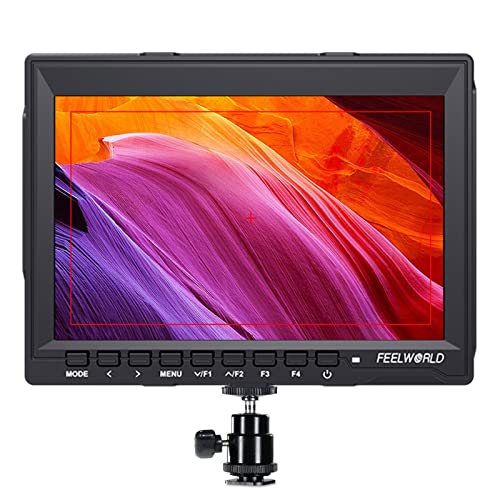
The FW759 is a 7-inch external monitor with 1280×800 resolution and a slim 17mm profile. It supports 4K HDMI input, including 3840x2160p at 30/29.97/25/24/23.98Hz formats. It provides typical monitoring tools, such as focus peaking, histogram, and false color, designed to improve framing, exposure, and overall shot quality. Best for lightweight rigs where portability is key.
Who it’s best for: creators using DSLRs or mirrorless cameras on stabilizers or gimbals who need a dependable, compact monitor without adding bulk. The slim design makes it easier to pack for travel shoots.
Limitation: The resolution is 1280×800, which is lower than some higher-end models; plan for this when evaluating fine detail on small screens.
NEEWER F100 7″ Field Monitor
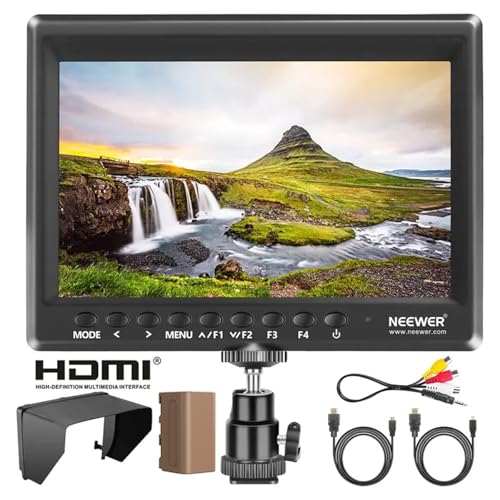
The F100 updates to a 7″ external field monitor with a 1280×800 IPS panel and 450 nits brightness. It includes peak focus, histogram, and a 360° ball head for flexible handheld operation. The unit ships with a F750 battery option and supports a broad range of recording formats, aiding in professional on-set monitoring and framing decisions. Best for balanced rigs that require reliable color accuracy and extended battery life in mobile setups.
Who it’s best for: filmmakers who want a robust, compact monitor with flexible power options and a solid feature set for quick on-set decisions. It works well with tripods, handheld rigs, and light stabilizers.
Caution: Battery life depends on usage and brightness; consider extra batteries for longer shoots or continuous daylight work.
Buying Guide
What should I consider when choosing a small HD monitor?
- Brightness and visibility: Outdoor shoots require high nit levels (1500–2000+nits) for clear viewing in sunlight.
- Resolution and panel type: IPS panels provide wide viewing angles and accurate colors; higher resolutions help with precise focus at distance.
- Monitoring tools: Waveform, vectorscope, histogram, and focus assist help maintain correct exposure and sharpness.
- LUT support: Real-time LUT preview is valuable for Log shooting and on-site color decisions.
- Input/output flexibility: 4K HDMI support and loop-through can simplify multi-camera setups and on-location workflows.
- Power and form factor: Battery life, weight, and mounting options affect portability and runtime on location.
What is the best choice for outdoor video work?
Monitors with 1500–2000+ nit brightness and sun shading are ideal for bright environments. The NEEWER F700 stands out for extreme brightness and robust LUT options, while FEELWORLD F5 Prox is a strong smaller alternative when weight and compactness matter.
What is the best option for indoor studios?
Indoor setups benefit from options with reliable color accuracy, good viewing angles, and panels that hold up under controlled lighting. FEELWORLD S55 V3 and FW759 provide dependable performance with practical toolsets and easy mounting in studio rigs.
How many LUTs should I expect to load?
Many models ship with preloaded LUTs (often around 10–15) and support additional user LUTs via SD card or internal storage. If you shoot with Log profiles frequently, ensure LUT support with easy preview.
Do I need 4K input on a small monitor?
4K HDMI input is beneficial when monitoring 4K footage or higher-resolution playback from modern cameras. If you primarily shoot in 1080p, a 4K-capable monitor is less critical but future-proofing can be convenient.
Is sun shade important?
Yes for outdoor filming. Several models include a sun hood or hood accessory to reduce glare and improve visibility, making exposure decisions easier in bright daylight.
Power considerations
Most monitors use external batteries or USB power options. Assess runtime needs for your typical shoot length and consider extra batteries or portable power banks for extended sessions.
Quick comparison at a glance
- Best brightness: NEEWER F700
- Best for outdoor portability: FEELWORLD F5 PROX
- Best indoor reliability: FEELWORLD S55 V3
- Best overall compact option: FEELWORLD FW759
- Best battery flexibility: NEEWER F100
Frequently Asked Questions
- What size monitor should I choose for travel filming? A: A 5.5–7 inch monitor balances portability with enough screen area for accurate focus and exposure checks.
- Do I need a touch screen on a field monitor? A: Touch can simplify quick adjustments, but not all workflows require it; many models offer both touch and non-touch controls.
- Which tool is most important for focus accuracy? A: Focus peaking and histogram are among the most useful tools for real-time focus verification.
- Can I use these monitors with any camera? A: Most external monitors support standard HDMI inputs and common video formats; verify compatibility with your camera’s output resolution and frame rates.
- Do these monitors affect battery life significantly? A: Larger brightness levels and advanced features can increase power consumption; plan for additional power sources on longer shoots.
- Is there a risk of latency with external monitors? A: Latency is typically low on modern field monitors, but it can vary by model and HDMI cable quality; choose models with low-latency specs for critical focus work.