If you want instant access to wildlife footage from your phone, these trail cameras offer cellular or local Wi‑Fi connectivity that streams or transmits images and videos directly to your device. They are ideal for hunters, wildlife observers, remote property monitoring, and game management. Below are five highly relevant options, with who they’re best for and why they stand out. A quick buying guide and FAQ follow for quick comparisons and answers to common buyer questions.
| Product | Best For | Key Benefit |
|---|---|---|
| Hunters managing large properties | Two cameras with cross-carrier connectivity and free photo transmission | |
| Remote locations with solar power | Self-contained WiFi/BT, rechargeable power, high-res imaging | |
| Easy setup in the field | Pre-installed SIM, free data testing, solar option | |
| Tech-forward scouting | Built-in SIM, AI detection, unlimited data options | |
| Compact, budget-conscious setup | Free photo transmission plan, no WiFi needed |
SPYPOINT Flex-M Twin Pack Cellular Trail Cameras

The SPYPOINT Flex-M Twin Pack delivers cross-carrier cellular connectivity and no need to swap SIMs. It supports night vision, GPS, and IP65 water resistance with 28MP photo capture and 720p video with sound. This twin-pack option targets property managers and serious scouts who want multiple cells deployed across a site. Best for those who value a ready-to-use cellular plan and straightforward activation. A potential limitation is reliance on cellular signal quality in remote areas, though the model continuously checks network performance to stay connected.
SPYPOINT Flex-M Twin Pack Cellular Trail Cameras (2) — Best Value
This twin-pack emphasizes value and simplicity. Each camera supports the brand’s free photo transmission plan (up to 100 photos per month) and features cross-carrier monitoring to minimize connectivity headaches. It is best for users who want multiple field cameras without complex setup. Consider potential limits on monthly transmissions if you exceed the free plan; paid plans are available for more monthly photos or unlimited access.
MAXDONE Solar WiFi Trail Camera Bluetooth 4K 64MP
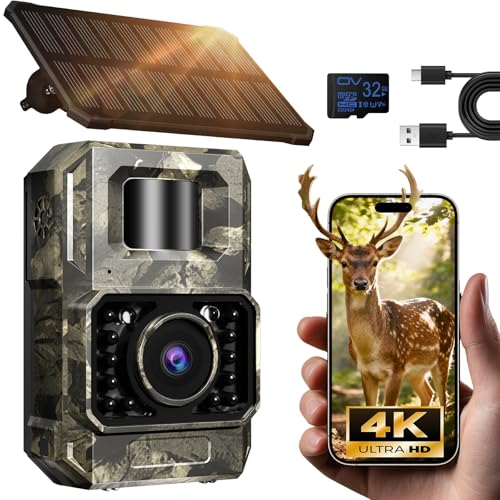
This MAXDONE model blends powered operation with local WiFi and Bluetooth for direct smartphone previews and downloads via an app, without cloud dependency. It’s best for scouts who prefer offline control and private data handling. The built-in rechargeable battery and solar panel extend field use, though note that WiFi range is typically limited and may require proximity to your device for quick setup and transfer.
MAXDONE Solar Trail Camera WiFi Bluetooth — 4K 64MP

This model emphasizes a solar-powered design with a rechargeable 6000mAh battery and an upgraded solar panel for flexible placement. It does not act as a home Wi‑Fi camera; it creates its own local network for setup and file transfer. Best for long hunts or remote sites where power is scarce. A limitation is the range of its local Wi‑Fi network for phone viewing, which is intended for field use rather than constant remote access.
4G LTE Cellular Trail Camera — 360° Live Streaming

This two-pack from VOOPEAK offers 4G cellular access, a pre-installed SIM with a free data test, solar compatibility, and motion-activated night vision. It’s best for users who want quick phone access to live or recent captures with the confidence of transparent data plans. The main caveat is that all cellular viewing requires a data plan; no free streaming is included beyond the test data.
Trail Camera Sends Pictures to Cell Phone — 60MP 4K

This Zivolixd unit pairs solar power with a built-in 5200mAh battery and a 60MP sensor that delivers 4K video. It includes a 32GB SD card and supports WiFi/Bluetooth connectivity for app-based control and remote viewing. It’s best for remote deployments where solar charging and high-resolution visuals are priorities. Note that app data transmission may not work over home Wi‑Fi and is intended for field use with the built-in cellular-like transfer mechanics.
Buying Guide: Key Considerations For Phone-Connected Trail Cams
- Connectivity type: Cellular vs. local Wi‑Fi. Cellular cameras send data over networks and require a data plan; Wi‑Fi cameras often transfer via a nearby phone or hotspot. Choose based on site accessibility and preferred transfer method.
- Power strategy: Solar panels, rechargeable batteries, or standard batteries. Solar helps in remote locations; ensure panel size and sun exposure align with your site.
- Image and video specs: Resolution, frame rate, and night‑vision range. Higher MP and 4K video improve clarity but consume more power and data.
- Data plans and costs: Free or tiered data plans influence long‑term costs. Look for plans that match your expected activity and camera count.
- Durability and weather rating: IP65/IP66 ratings indicate weather resistance. This matters for outdoor exposure and long-term deployments.
- Setup and app usability: An intuitive app speeds setup and remote management. Consider whether the camera supports multi-user access if you scout with others.
- Privacy and data handling: Local processing and on-device apps reduce cloud reliance. Verify data handling and privacy options if sensitive locations are involved.
Frequently Asked Questions
- What is the main difference between cellular and Wi‑Fi trail cameras? Cellular cameras transmit data over cellular networks to your phone; Wi‑Fi cameras rely on local networks or direct phone connections for transfers.
- Do these cameras require a subscription? Some include free plans for limited transmissions; others require ongoing data plans for remote access and cloud features.
- Can you use solar power with these cameras? Yes. Solar options extend field use and reduce battery changes, especially in remote locations.
- Is a SIM card included? Some models come with pre-installed SIMs or offer a built-in SIM; check each product for plan and activation details.
- What should I consider for coverage? Choose cameras with cross-carrier monitoring or strong local signal in your target area to improve reliability.
- Are these cameras suitable for continuous live streaming? Most are designed for motion-triggered captures with periodic remote access; continuous live streaming can drain power and data quickly.