For aquarists and pond owners seeking reliable underwater IP cameras, the right choice hinges on waterproofing, image quality, and easy remote access. This guide highlights five top options that balance 5MP or 4K resolution, robust IP68 protection, and POE connectivity to keep your aquatic setup secure. Best fits include serious hobbyists, commercial aquaculture operators, and DIY pond enthusiasts who want stable, remote monitoring.
| Product | Best For |
|---|---|
| Barlus Underwater Cameras 304 Stainless Steel IP68 5MP | Koi ponds and permanent freshwater installs |
| LINOVISION 4K Underwater Camera with Anti-Corrosion Coating | Aquaculture farms and large tanks |
| Barlus Underwater Camera 5MP With 32ft Cable | Live streaming and mobile viewing |
| Barlus HD Aquarium POE Underwater Camera | Full HD underwater monitoring with long cable |
| LINOVISION 4K With POE Switch And 99ft Cable | Professional multi-site deployments |
Barlus 5MP Underwater IP Camera with POE

The Baruls 5MP Underwater IP Camera delivers crisp 2592×1944 imaging with Power-over-Ethernet for a single-cable setup. This option is best for permanent freshwater ponds where saltwater exposure is not a factor. It is ideal for hobbyists or small installations wanting high-resolution footage without complex wiring.
- Best for: Koi ponds and fixed freshwater installations
- Why selected: 5MP resolution with reliable IP68 waterproofing and a single 32 ft cable simplifies setup.
- Limitation: Saltwater environments are not supported.
LINOVISION 4K Underwater IP Camera with Anti-Corrosion Coating

This LINOVISION model brings 4K Ultra HD undersea surveillance with anti-corrosion coating and a dedicated anti-corrosion cable. It supports remote access via a web GUI and mobile app, making it suitable for aquaculture farms, large aquariums, and water facilities where long-term underwater use is needed.
- Best for: Aquaculture farms, large aquariums, and water facilities
- Why selected: 8 MP equivalent imaging, advanced compression, and robust corrosion resistance for long-term underwater use.
- Limitation: May require higher bandwidth in busy networks.
Barlus POE 5MP Underwater Camera With Fill Light

This Baruls model combines a 5MP CMOS lens with a 100° wide angle and a fill light system. It is best for ongoing 24/7 koi pond monitoring where clear illumination and real-time viewing are required, with a sturdy stainless steel build for underwater use.
- Best for: 24/7 pond surveillance with enhanced lighting
- Why selected: Strong lighting and wide-angle view help capture more detail underwater.
- Limitation: Lighting adds power needs; ensure POE installation is correct.
Barlus 5MP HD Aquarium POE Underwater Camera

This model emphasizes professional full HD underwater video with infrared and white LED lighting. It uses a 30 m cable to cover larger tanks or outdoor ponds. It is best when you need consistent daylight-like illumination and simple remote viewing from a PC or app.
- Best for: Large tanks and outdoor ponds requiring long cable runs
- Why selected: Balanced 5MP imaging with adjustable lighting for variable underwater conditions.
- Limitation: Longer cables can complicate installation and routing.
LINOVISION 4K Ultra HD With Anti-Corrosion Coating And POE
This LINOVISION option features 4K Ultra HD underwater imaging, a corrosion-resistant design, and a cloud-enabled remote GUI with API access. It’s well-suited for multi-site deployments across aquaculture, aquariums, and water facilities that require centralized management and scalable installation.
- Best for: Professional multi-site deployments
- Why selected: 4K details with a robust remote management suite and API access.
- Limitation: Setup can be more involved due to POE and network requirements.
LINOVISION 4K Ultra HD With POE Switch And Long Cable
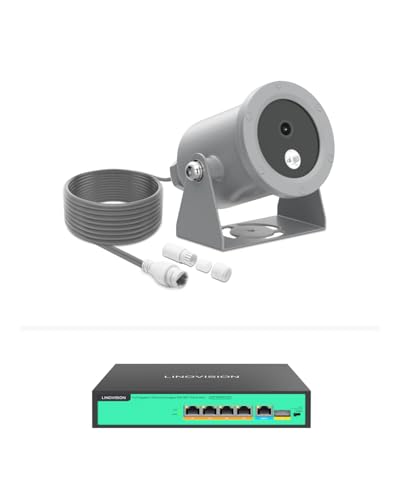
This configuration includes a 4K underwater camera plus a four-port POE switch and a lengthy underwater cable. It is best for projects needing straightforward wiring, centralized control, and multiple camera installation across larger aquatic facilities.
- Best for: Centralized control across several underwater cameras
- Why selected: The switch simplifies wiring and expands future camera deployments.
- Limitation: Requires compatible network infrastructure and power provisioning.
Buying Guide
Key factors to consider when choosing an underwater IP camera for aquariums or ponds include image resolution, waterproofing, cable length, and remote access features. A higher resolution improves detail in underwater scenes, but it also increases bandwidth needs. IP68-rated cameras protect against immersion, but ensure the environment (saltwater vs freshwater) is compatible with the device.
- Resolution vs. bandwidth: 4K offers greater detail; verify your network capacity and storage plans.
- Cable length and POE: Longer cables simplify power and data delivery, but require robust installation planning.
- Corrosion resistance: Anti-corrosion coatings help in salty or aggressive water environments; stainless steel housings are common.
- Remote access: Web GUI and mobile apps enable live viewing and playback from anywhere; consider API access for integration.
- Lamps and lighting: Infrared and white LEDs assist low-light conditions; check brightness levels and heat output for fish safety.
FAQ
- What is the advantage of POE for underwater cameras?
POE delivers both power and data through a single network cable, reducing wiring complexity and allowing longer cable runs without separate power lines.
- Can these cameras be used in saltwater?
Some models specify freshwater use; always confirm saltwater compatibility before deployment.
- Is 4K necessary for aquarium cameras?
4K provides finer underwater details, which helps identify fish behavior and plant placement, but requires more bandwidth and storage.
- What should I consider for remote viewing?
Ensure the camera offers a stable web GUI or mobile app, with options to centralize viewing via PC software or cloud access.
- How long should a camera cable be?
Choose a length that fits your tank or pond dimensions; longer cables increase installation flexibility but may add cost and weight.