Answering the demand for reliable, wildlife-friendly video cameras, this guide highlights five standout options ideal for backyard, farm, or remote-area observation. These models emphasize long battery life, quick trigger speeds, and clear night vision to capture natural behavior without disturbance. Best for: property owners seeking solar or rechargeable power, beginners needing simple setup, and wildlife enthusiasts needing high-resolution footage.
| Product | Key Benefit | Best For |
|---|---|---|
| Misstech 4K UHD Solar Trail Camera | 4K video, 64MP photos, 0.1s activation, solar powered | Eco-friendly, high-detail daytime/night footage |
| CEYOMUR Trail Camera | 850nm night vision, simple setup, IP66 waterproof | Beginner-friendly wildlife monitoring |
| MAXDONE Solar WiFi Trail Camera | 4K 64MP, wireless control, solar-powered | Remote viewing with solar efficiency |
| SPYPOINT Flex-M Twin Pack Cellular Trail Cameras | Cellular transmission, free photo plan, cross-carrier coverage | Mobile monitoring with cellular alerts |
| KJK Trail Camera | 36MP, 2.7K video, 0.1s trigger, 130° wide view | High-resolution capture with wide-angle coverage |
Misstech 4K UHD Solar Trail Camera

The Misstech model combines solar power with high-resolution capture to reduce maintenance in outdoor settings. It records 4K video and 64MP stills, providing sharp details even in challenging light. Its 0.1-second activation ensures quick action is captured, making it suitable for deer, birds, and other fast-moving wildlife. Best for property owners who want long-term, hands-off operation with clear daytime and nighttime footage. A potential limitation is that the data relies on local storage and may require an external card for extensive capture sessions.
CEYOMUR Trail Camera

The CEYOMUR camera emphasizes ease of use and robust night vision. It is designed for beginners who want a straightforward setup and dependable field performance. The 850nm infrared LEDs deliver brighter, sharper nighttime images with less noise compared with some alternatives, helping identify wildlife activity after dark. Best for first-time users, small properties, or educational plots. Note that batteries and memory cards are not included, so initial setup requires separate purchases.
MAXDONE Solar WiFi Trail Camera
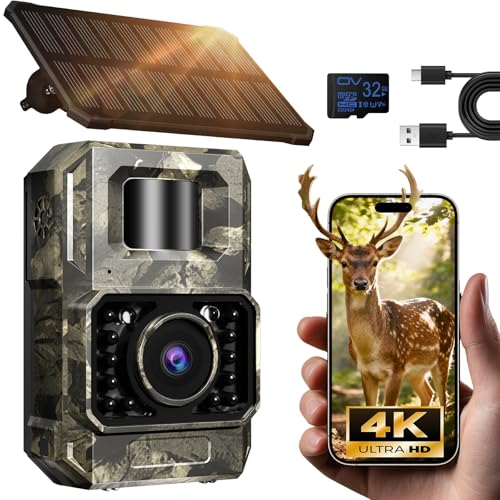
This MAXDONE model features a built-in rechargeable battery with a detachable solar panel, enabling longer trips and reduced maintenance. It supports WiFi and Bluetooth for local control via the TrailCam GO app, with data processing staying local to protect privacy. Night vision uses up to 65 feet of no-glow infrared, balancing brightness and animal comfort. Best for users who want solar power with flexible placement and private on-device data handling. A limitation is that it operates without cloud connectivity, so remote viewing requires local access via the app.
SPYPOINT Flex-M Twin Pack Cellular Trail Cameras

The SPYPOINT Flex-M Twin Pack delivers cellular connectivity with a free photo transmission plan and cross-carrier coverage. It is designed for users who prefer remote monitoring without frequent site visits. The twin-pack option increases coverage across larger properties. Best for hunters and landowners who want real-time alerts and a simple activation process. A caution is that cellular plans may need to be managed and updated to maintain continuous service, depending on location and carrier conditions.
KJK Trail Camera

The KJK camera delivers 36MP stills and 2.7K video with a broad 130-degree field of view. Its low-glow infrared LEDs minimize disturbance to wildlife while capturing nocturnal activity. The 0.1-second trigger speed helps ensure you don’t miss fast movements. This model suits observers who want a high-resolution, wide-angle setup for expansive landscapes. A potential caveat is that battery life may vary with the intensity of use and the climate, so plan for regular power checks during long sessions.
Buying Guide: Key Considerations For Wildlife Camera Purchases
- Power source: Solar, rechargeable, or traditional batteries. Solar options reduce maintenance, but may depend on sun exposure.
- Trigger speed and burst modes: Faster triggers (0.1s or quicker) capture quick movements; burst modes help document multiple frames of a sighting.
- Resolution and night vision: Higher megapixels and 4K video provide more detail, though file sizes increase. No-glow IR extends nighttime operation with less animal disturbance.
- Storage and data handling: Local storage vs. cellular transmission. Cellular models require data plans; local-storage models need SD cards.
- Durability and weather sealing: IP66 or higher ratings protect against dust and water in outdoor settings.
- Field setup: One-sided designs or integrated screens can speed up field adjustments and angle changes.
- Privacy and data handling: Models with on-device processing and local data storage may offer better privacy.
Frequently Asked Questions
- What is the best camera for night wildlife footage? Look for models with high-quality no-glow infrared night vision and large image sensors; 850nm LEDs are common and effective.
- Do solar-powered trail cameras work year-round? Yes, when exposed to sufficient sunlight and a capable built-in or external battery; always consider local weather conditions.
- Are cellular cameras worth it for remote areas? They’re valuable for real-time alerts and remote viewing, but require reliable cellular coverage and data plans.
- Is 4K necessary for wildlife monitoring? 4K provides more detail for identifying animals but produces larger files; choose based on your needs and storage capacity.
- Can these cameras be used for property security? Many models offer quick trigger speeds and motion-activated recording that suit surveillance in addition to wildlife monitoring.
- Do these cameras require Wi-Fi to work? Some do not require home Wi-Fi and operate via local networks or offline storage; verify each model’s connectivity options.
By aligning your choice with your site conditions, power availability, and monitoring goals, you can select a wildlife video camera that balances durability, image quality, and ease of use. The five options highlighted above cover a range from beginner-friendly to feature-rich, solar-powered, and cellular-connected devices.