Answering the demand for clear vision in total darkness, smoke, or foliage, these thermal overlay night vision devices fuse heat sensing with traditional night vision. They are best for tactical users, hunters, search-and-rescue teams, and outdoor professionals who need reliable situational awareness in low-visibility conditions. This guide highlights five options that pair thermal imagery with night vision or digital overlays, helping buyers compare capabilities, use cases, and potential limitations at a glance.
| Selected Products | Why It Appears Here |
|---|---|
| AGM Global Vision F14-3APW Fusion Tactical Night Vision Monocular | Hybrid Gen 3 white phosphor NV with thermal overlay; high FOM; helmet/weapon mounting. |
| Pulsar Symbion DXR50 LRF Thermal and Digital Night Vision Binoculars | Multispectral platform with built-in laser rangefinder; long-range detection. |
| Pulsar Symbion DXT50 LRF Thermal and Digital Night Vision Binoculars | Similar multispectral approach; high sensitivity thermal, rangefinding capabilities. |
| Adjustable thermal sensor and diopter bridging for clarity in darkness. | |
| MiLESEEY TNV30i Thermal Monocular | 512×384 super-resolution with AI processing for clearer imagery; versatile viewing modes. |
AGM Global Vision F14-3APW Fusion Tactical Night Vision Monocular

Best for: Law enforcement, special operations, and search-and-rescue teams needing both thermal overlay and elite night vision in one compact unit. Why selected: It combines Gen 3 white phosphor NV with a 640×512 thermal overlay, delivering high-contrast detail in total darkness and in smoke or foliage. The dual-channel fusion supports detection, recognition, and engagement across challenging environments. The unit is helmet-mountable and adaptable for weapon use, increasing versatility in field operations.
Limitation: As a premium device, users should account for the weight and potential complexity of integration with existing kit. It may require familiarization for effective weapon-mount operation.
Night Operators Heat Thermal Vision Monocular
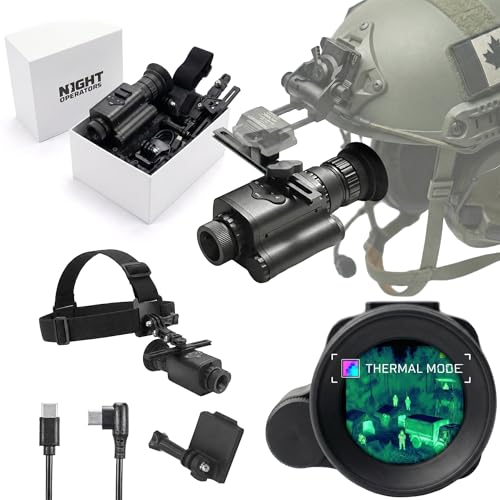
Best for: Operators who need a straightforward thermal monocular for quick target spotting in complete darkness. Why selected: It emphasizes a focused thermal sensor with adjustable focus and diopter bridging, helping users lock onto heat signatures from humans or vehicles. The device supports practical, on-the-go scenarios where speed matters.
Limitation: This model centers on thermal sensing; it does not include the same native integrated night vision overlay or digital enhancement features found in dual-channel systems.
Husk Masida Thermal Imaging Night Vision Scope

Best for: Hunters and outdoor professionals needing a rugged, weather-sealed thermal scope for long-range detection. Why selected: It offers high-resolution thermal imaging, a 50 Hz refresh rate, and 3x digital zoom for up to 100 meters visibility, along with IP66 protection for harsh environments. This makes it a reliable choice for variable weather conditions.
Limitation: Its primary strength is thermal imaging; users seeking dual NV and thermal overlay features may want a model with native night vision channels or fusion capability.
MiLESEEY TNV30i Thermal Monocular

Best for: Anyone seeking a compact thermal monocular with AI-enhanced clarity for versatile field use. Why selected: The TNV30i uses Matrix IV AI processing and 12 µm pixel size with 512×384 resolution for clearer thermal images. It includes 10–15 mm focusing for flexible viewing and up to 1600 yards detection with a fast lens, beneficial for distant targets in total darkness.
Limitation: As a thermal-focused device, it does not inherently provide an integrated night-vision overlay or a multi-sensor fusion experience like dual-channel systems.
Buying Guide: Key Considerations For Thermal Overlay Night Vision
What is your primary use case? If you need fusion of thermal with night vision for rapid target identification, prioritize models with dual-channel fusion and higher FOM. For long-range scouting, look at devices with large detection distances and high-resolution thermal sensors.
Which features matter most? Consider:
- Thermal sensor resolution and NETD (thermal sensitivity) for detecting subtle heat differences.
- Night vision channel type (Gen 3 white phosphor, dual-channel fusion, or digital overlay).
- Display refresh rate and lag, important for dynamic scenes or moving targets.
- Field of view and focal range to balance scanning versus target detail.
- Mounting compatibility (helmet, weapon, or handheld) and weight for field wearability.
What are practical trade-offs? Fusion devices deliver richer information but may be heavier and costlier. Pure thermal monoculars are lighter and simpler but lack integrated night-vision overlay.
How to compare effectively? Use direct statements such as best for, better for, and choose this if to evaluate target acquisition, range, and environmental conditions. Consider potential limitations like the need for accessory mounting or the lack of waterproofing in certain models.
FAQ
- What is thermal overlay night vision?
It combines heat-imaging data with traditional night-vision or digital overlays to reveal hidden heat sources in darkness. - Which device offers dual-channel fusion?
The AGM F14-3APW Fusion Tactical Night Vision Monocular provides a Gen 3 white phosphor NV channel with a thermal overlay. - Do these devices require special training?
Basic training helps with mounting, focusing, and interpreting heat signatures. More complex fusion systems may require hands-on practice. - Are rangefinders common in these devices?
Some models, like Pulsar Symbion DXR50/ DXT50, include built-in laser rangefinders for distance measurement. - Can I use these devices in rain or dust?
Protection varies by model. Look for IP ratings (e.g., IP66) for rugged environments and harsh conditions. - Which is the most versatile for hunting in total darkness?
Models with both thermal and digital/night-vision overlays, such as the Pulsar Symbion DXR50 or DXT50, tend to offer the broadest utility.